

Died May 21st, 1981
A quiet, good-natured and discreet republican
A quiet, good-natured and discreet republican
The third of the resolutely determined IRA Volunteers to join the H-Block hunger strike for political status was twenty-four-year-old Raymond McCreesh, from Camlough in South Armagh: a quiet, shy and good-humoured republican, who although captured at the early age of nineteen, along with two other Volunteers in a British army ambush, had already almost three years active republican involvement behind him.
During those years he had established himself as one of the most dedicated and invaluable republican activists in that part of the six counties to which the Brits themselves have – half-fearfully, half-respectfully – given the name ‘bandit country’ and which has become a living legend in republican circles, during the present war, for the courage and resourcefulness of its Volunteers: the border land of South Armagh.
Raymond’s resolve to hunger strike to the death, to secure the prisoners’ five demands was indicated in a smuggled-out letter written by Paddy Quinn, an H-Block blanket man – who was later to embark on hunger strike himself – who was captured along with Raymond and who received the same fourteen year sentence: “I wrote Raymie a couple of letters before he went to the prison hospital. He wrote back and according to the letter he was in great spirits and very determined. A sign of that determination was the way he finished off by saying: Ta seans ann go mbeidh me abhaile rombat a chara’ which means: There is a chance that I’ll be home before you, my friend!”
Captured in June 1976, and sentenced in March 1977, when he refused to recognise the court, Raymond would have been due for release in about two years’ time had he not embarked on his principled protest for political status, which led him, ultimately, to hunger strike.
FAMILY
Raymond Peter McCreesh, the seventh in a family of eight children, was born in a small semi-detached house at St. Malachy’s Park, Camlough – where the family still live – on February 25th, 1957.
The McCreeshes, a nationalist family in a staunchly nationalist area, have been rooted in South Armagh for seven generations, and both Raymond’s parents – James aged 65, a retired local council worker, and Susan (whose maiden name is Quigley), aged 60 – come from the nearby townland of Dorsey.
Raymond was a quiet but very lively person, very good-natured and – like other members of his family – extremely witty. Not the sort of person who would push himself forward if he was in a crowd, and indeed often rather a shy person in his personal relationships until he got to know a person well. Nevertheless, in his republican capacity he was known as a capable, dedicated and totally committed Volunteer who could show leadership and aggression where necessary.
Among both his family and his republican associates, Raymond was renowned for his laughter and for “always having a wee smile on him”. His sense of humour remained even during his four-year incarceration in the H-Blocks, as well as during his hunger strike where he continued to insist that he was “just fine.”
SCHOOL
Raymond went first to Camlough primary school, and then to St. Coleman’s college in Newry. It was at St. Coleman’s that Raymond met Danny McGuinness, also from Camlough, and the two became steadfast friends. They later became republican comrades, and Danny too then a nineteen-year-old student who had just completed his ‘A’ levels was captured along with Raymond and Paddy Quinn, and is now in the H-Blocks.
At school, Raymond’s strongest interest was in Irish language and Irish history, and he read widely in those subjects. His understanding of Irish history led him to a fervently nationalist outlook, and he was regarded as a ‘hothead’ in his history classes, and as being generally “very conscious of his Irishness”.
He was also a sportsman, and played under-sixteen and Minor football for Carrickcruppin Gaelic football club as well as taking a keen interest in the local youth club where he played basketball and pool, and was regarded a good snooker player.
When he was fourteen years old, Raymond got a weekend job working on a milk round through the South Armagh border area, around Mullaghbawn and Dromintee. Later on, after leaving his job in Lisburn, he worked full-time on the milk round, where he would always stop and chat to customers. He became a great favourite amongst them and many enquired about him long after he left the round.
RESISTANCE
During the early ‘seventies, the South Armagh border area was the stamping ground of the British army’s Parachute regiment, operating out of Bessbrook camp less than two miles from Raymond’s home. Stories of their widespread brutality and harassment of local people abound, and built-up then a degree of resentment and resistance amongst most of the nationalist population that is seen to this day.
The SAS terror regiment began operating in this area in large numbers too, in a vain attempt to counter republican successes, and the high level of assassinations of local people on both sides of the South Armagh border, notably three members of the Reavey family in 1975, was believed locally to have been the work both of the SAS, and of UDR and RUC members holding dual membership with ‘illegal’ loyalist paramilitary organisations.
Given this scenario and Raymond’s understanding of Irish history, it is small wonder that he became involved in the republican struggle.
JOINED
He first of all joined na Fianna Eireann early in 1973 and towards the end of that year joined the Irish Republican Army’s 1st Battalion, South Armagh.
Even before joining the IRA, and despite his very young age, Raymond – with remarkable awareness and maturity – became one of the first Volunteers in the South Armagh area to adopt a very low, security conscious, republican profile.
He rarely drank, but if occasionally in a pub he would not discuss either politics or his own activities, and he rarely attended demonstrations or indeed anything which would have brought him to the attention of the enemy.
It was because of this remarkable self-discipline and discretion that during his years of intense republican involvement Raymond was never once arrested or even held for screening in the North, and only twice held briefly in the South.
Consequently, Raymond was never obliged to go ‘on the run’, continuing to live at home until the evening of his capture, and always careful not to cause his family any concern or alarm.
Fitted in with his republican activities Raymond would relax by going to dances or by going to watch football matches at weekends.
WORK
After leaving school he spent a year at Newry technical college studying fabrication engineering, and afterwards got a job at Gambler Simms (Steel) Ltd. in Lisburn. He had a conscientious approach to his craft but was obliged to leave after a year because of a fear of assassination.
Each day he travelled to work from Newry, in a bus along with four or five mates who had got jobs there too from the technical college, but the prevailing high level of sectarian assassinations, and the suspicion justifiably felt of the predominantly loyalist work-force at Gambler Simms, made Raymond, and many other nationalist workers, decide that travelling such a regular route through loyalist country side was simply too risky.
So, after leaving the Lisburn factory, Raymond began to work full-time as a milk roundsman, an occupation which would greatly have increased his knowledge of the surrounding countryside, as well as enabling him to observe the movements of British army patrols and any other untoward activity in the area.
ACTIVITY
Republican activity in that area during those years consisted largely of landmine attacks and ambushes on enemy patrols.
Raymond had the reputation of a republican who was very keen to suggest and take part in operations, almost invariably working in his own, extremely tight, active service unit, though occasionally, when requested – as he frequently was – assisting other units in neighbouring areas with specific operations. He would always carefully consider the pros and cons of any operation, and would never panic or lose his nerve.
In undertaking the hunger strike, Raymond gave the matter the same careful consideration he would have expended on a military operation, he undertook nothing either a rush, or for bluff.
CAPTURE
The operation which led to the capture of Raymond, his boyhood friend, Danny McGuiness, and Patrick Quinn, took place on June 25th, 1976.
An active service unit comprising these three and a fourth Volunteer arrived in a commandeered car at a farmyard in the town land of Sturgan a mile from Camlough – at about 9.25 p.m.
Their objective was to ambush a covert Brit observation post which they had located opposite the Mountain House Inn, on the main Newry – Newtonhamilton Road, half-a-mile away. They were not aware, however, that another covert British observation post, on a steep hillside half-a-mile away, had already spotted the four masked, uniformed and armed Volunteers, clearly visible below them, and that radioed helicopter reinforcements were already closing in.
As the fourth Volunteer drove the commandeered car down the road to the agreed ambush point, to act as a lure for the Brits, the other three moved down the hedgeline of the fields, into position. The fourth Volunteer, however, as he returned, as arranged, to rejoin his comrades, spotted the British Paratroopers on the hillside closing in on his unsuspecting friends and, although armed only with a short range Stengun, opened fire to warn the others.
Immediately, the Brits opened fire with SLRs and light machine-guns, churning up the ground around the Volunteers with hundreds of rounds, firing indiscriminately into the nearby farmhouse and two vehicles parked outside, and killing a grazing cow!
The fourth Volunteer was struck by three bullets, in the leg, arm and chest, but managed to crawl away and to elude the massive follow up search, escaping safely – though seriously injured – the following day.
Raymond and Paddy Quinn ran zig-zag across open fields to a nearby house, under fire all this time, intending to commandeer a car. Unfortunately, the car belonging to the occupants of the house was parked at a neighbour’s house several hundred yards away. Even then the pair might have escaped but that they delayed several minutes waiting for their comrade, Danny McGuinness, who however had got separated from them and had taken cover in a disused quarry outhouse (where he was captured in a follow-up operation the next day).
The house in which Raymond and Paddy took cover was immediately besieged by berserk Paratroopers who riddled the house with bullets. Even when the two Volunteers surrendered, after the arrival of a local priest, and came out through the front door with their hands up, the Paras opened fire again and the Pair were forced to retreat back into the house.
On the arrival of the RUC, the two Volunteers again surrendered and were taken to Bessbrook barracks where they were questioned and beaten for three days before being charged.
REMARKABLE
One remarkable aspect of the British ambush concerns the role of Lance-Corporal David Jones, a member of the 3rd Battalion, the Parachute regiment. According to Brit statements at the trial it was he who first opened up on the IRA active service unit from the hillside.
Nine months later, on March 16th, 1977 two IRA Volunteers encountered two Paratroopers (at the time seconded to the SAS) in a field outside Maghera in South Derry. In the ensuing gun battle, one SAS man was shot dead, and one IRA Volunteer was captured. The Volunteer’s name was Francis Hughes, the dead Brit was Lance-Corporal David Jones of the Parachute regiment.
In the eighteen months before going on hunger strike together neither Raymond McCreesh or Francis Hughes were aware of what would seem to have been an ironic but supremely fitting example of republican solidarity!
After nine months remand in Crumlin Road jail, Raymond was tried and convicted in March 1977, of attempting to kill Brits, possession of a Garand rifle and ammunition, and IRA membership. He received a fourteen-year sentence, and lesser concurrent sentences, after refusing to recognise the court.
In the H-Blocks he immediately joined the blanket protest, and so determined was his resistance to criminalisation that he refused to take his monthly visits for four years, right up until he informed his family of his decision to go on hunger strike on February 15th, this year. He also refused to send out monthly letters, writing only smuggled ‘communications’ to his family and friends.
The only member of his family to see him at all during those four years in Long Kesh two or three times – was his brother, Fr. Brian McCreesh, who occasionally says Mass in the H-Blocks.
HUNGER STRIKE
Like Francis Hughes, Raymond volunteered for the earlier hunger strike, and, when he was not chosen among the first seven, took part in the four-day hunger strike by thirty republicans until the hunger strike ended on December 18th, last year.
Speaking to his brother, Malachy, shortly after Bobby Sands death, Raymond said what a great loss had been felt by the other hunger strikers, but it had made them more determined than ever.
And still managing to keep his spirits up, when told of his brother, Fr. Brian, campaigning for him on rally platforms, Raymond joked: “He’ll probably get excommunicated for it.”
To Britain’s eternal shame, the sombre half-prediction made by Raymond to his friend Paddy Quinn – Ta seans ann go mbeid me abhaile rombat – became a grim reality. Bhi se. Raymond died at 2.11 a.m. on Thursday May 21st, 1981, after 61 days on hunger strike.

© 2013 Irish Republican News


 Tuesday December 11, 2012 22:41
 by Brian Clarke - AllVoices

 printable version


 Digg this
 del.icio.us
 Furl
Furl Reddit
 Technorati
 Facebook
View Comments Titles Only
save preference
Comments (13 of 13)
Jump To Comment: 1 2 3 4 5 6 7 8 9 10 11 12 13Her government called for injunctions around the world, against Peter Wrights’s revelations about Britain's secret service activity. His book was available in most good shops.Thatcher thought that her government had a firm grip on unauthorized disclosures, with a host of sanctions against curious reporters, whistle blowers and judges. Attorney General Sir Patrick Mayhew declined to prosecute RUC officers, implicated in the Shoot-to-Kill controversy, for fear their trials would raise questions, about the activities of leading double agents in the PIRA leadership, particularly anything which would compromise a planned SAS murder, of unarmed IRA volunteers in March 1988 in Gibraltar.
Thatcher created an inner cabinet of Foreign Secretary Howe, Foreign Office, David Mellor, Permanent Under Secretaries F. O.’s Tim Eggar, a few Whitehall and Cabinet Office officials with Cabinet Secretary Robert Armstrong, to ensure its covert actions were on the same page as the Joint Intelligence Committee suggestions from reports by GCHQ, MI6, MI5, and FRU. It was the way that Mrs Thatcher unprecedentedly operated, at the expense of the intelligence services, and the Cabinet.
Margaret Thatcher was a control freak, totally addicted to special operations and consequently, had a need to know every detail of secret information which went way beyond that of everyone else. According to the Chancellor of the Exchequer Nigel Lawson, she was besotted with everything about intelligence, particularly the Force Research Unit’s Military Intelligence Source Reports (MISRs) in British Occupied Ireland. We can be certain she was fully aware of the details of the assassination of Lawyer Pat Finucane.
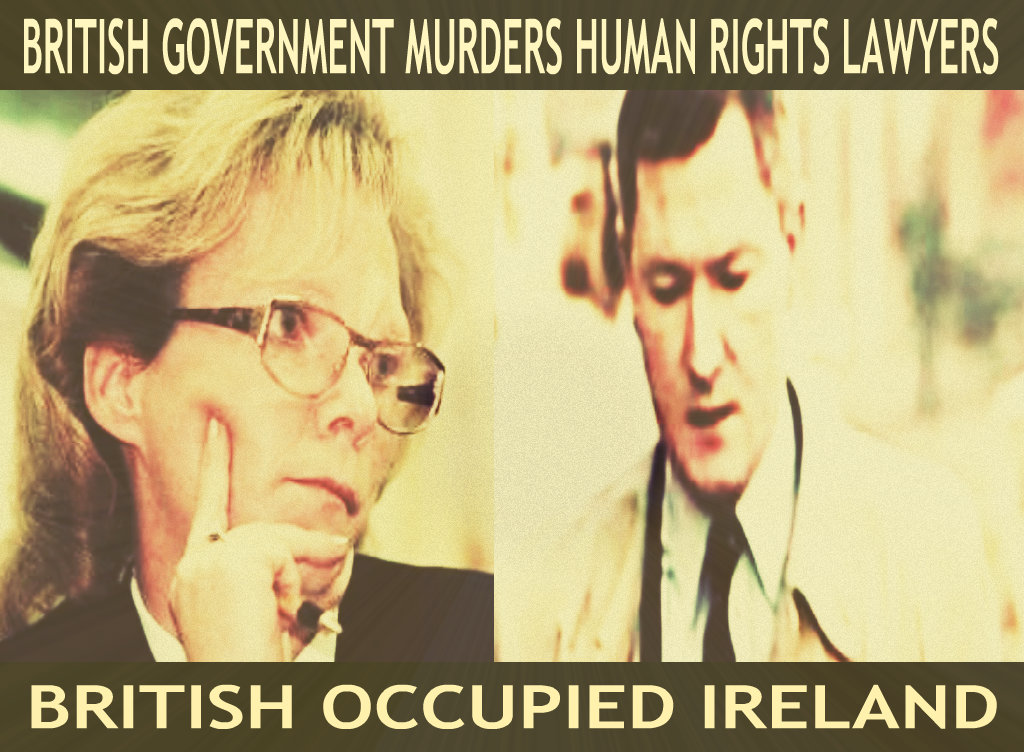
It was on Margret Thatcher's watch, that Human Rights lawyer Pat Finucane was murdered, which set the culture in motion, for the subsequent murder of a second human rights lawyer Rosemary Nelson. We can be certain the British Government's cover-up will continue, until she joins her peadofile, necrophilliac, friend Jimmy Savile in Hades.
Geraldine Finucane
We dont live in a democracy,the people have a right to know,and these people who colluded in the assasinations should not be allowed to walk free,get on with their lives and live on high salaries which they probably do.
Geraldine Finucane, widow of murdered solicitor Pat Finucane
The latest British inquiry into the death of Pat Finucane is again leaving massive questions unanswered.
The Guardian newspaper editorial headline said it best; “Pat Finucane murder: collusion, contrition, but not the whole truth.”
My strong belief is that the whole truth is that Margaret Thatcher ordered the Pat Finucane murder on February 12, 1989.
That is the key reason that no British Prime Minister will ever allow a public inquiry into the killing of the Belfast civil rights lawyer gunned down in front of his wife and children at his home.
He was shot 14 times while his widow, Geraldine, who was injured, tried to save him.
His only offense was to defend suspected IRA men and women too well in their court hearings.
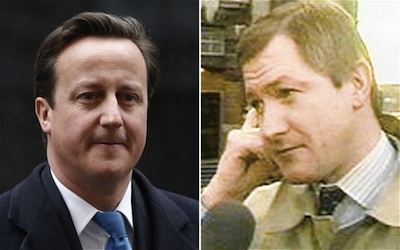
I am not at all surprised that David Cameron uttered words of regret and then refused a public inquiry after the Da Silva report was issued yesterday.
Geraldine Finucane, a woman of immense courage,called it for what it was.
“This report is a sham. This report is a whitewash. This report is a confidence trick dressed up as independent scrutiny and given invisible clothes of reliability. Most of all, most hurtful and insulting of all, this report is not the truth,” she told reporters afterwards.
Read more: Inquiry into death of Belfast solicitor Pat Finucane shows ‘shocking levels of collusion’
She knows what the truth is. The order to kill her husband came all the way from the top and David Cameron or any other British Prime Minister can never allow that truth to be revealed.
He can’t admit the British kill civil rights lawyers, can he?
Patrick Finucane was bringing the case of the Gibraltar 3, three IRA members shot dead in cold blood in March 1988, to Europe, which was going to be a massive embarrassment for Thatcher, who very likely gave the order for them to be shot dead also.
That court later found the three had been shot unlawfully. They had their hands up in surrender when they were shot down.
Finucane was doomed by a top government official. A member of Thatcher’s government Douglas Hogg, a Home Office minister, stood up in the House of Commons three weeks before Finucane was murdered and stated that some lawyers in Northern Ireland were "unduly sympathetic" to Irish Republicans.
He was directly referring to Finucane and signaling the killers to go ahead.
The new inquiry shows that MI5 was perfectly aware of the Finucane murder plot as were the RUC Special branch.
The Stevens inquiry into the Finucane killings stated, “My Enquiry team also investigated an allegation that senior RUC officers briefed the Parliamentary Under-Secretary of State for the Home Department, the Rt Hon Douglas Hogg QC, MP, that ‘some solicitors were unduly sympathetic to the cause of the IRA.”
Mr Hogg repeated this view...and the Enquiry concludes that “the Minister was compromised.”
In this latest enquiry, Sir Desmond Da Silva wrote, "My review of the evidence relating to Patrick Finucane's case has left me in no doubt that agents of the State were involved in carrying out serious violations of human rights up to and including murder."
Those agents did not act alone, they did so on orders from on high -- all the way to 10 Downing Street.
Thatcher’s reaction to the finding that her minister was responsible for the death of a lawyer?
She promoted him to Minister for Agriculture, all the better to keep him quiet.
Hogg was not alone in fingering Finucane of course. It went much higher in the government, all the way to the top.
It was a time when Thatcher apparently believed she could win the war if only those pesky lawyers would stop getting guilty terrorists off. She also faced massive embarrassment in Europe over the Gibraltar killings.
The killing was sanctioned and carried out by the British state. Of all the crimes committed in Northern Ireland, the Finucane murder is the one which successive British government, of whatever hue, have most resisted investigating.
Pat’s problem was that he was too good at his job of defending Irish men and women arrested for alleged crimes against the state.
He had to be got rid of. The leader of the gang that killed him was a British special branch agent named Tommy Lyttle. The man who confessed to being the Ulster Defense Association hit man was Ken Barrett, also a special branch agent.
The UDA man who supplied the gun was William Stobie, also a special branch agent. He was killed by the UDA, by a British agent in 2001, when he threatened to tell the truth about what happened to Pat Finucane.
Hogg and Thatcher might as well have been in the room when the gun went off fourteen times - they were just as culpable. The naming was the equivalent of painting a target on Finucane’s back - everyone knew who Hogg meant.
The British government had made their preference known.
And all the whitewash in the world will never remove the truth about what happened to Pat Finucane
See more: Irish News, Margaret Thatcher, Pat Finucane, IRA. Irish history.
Margaret Thatcher's Government Murdered Human Rghts Lawyers
The above excerpt has been copied from the United Nation text in the February 5th 2005 document titled "Updated Set of principles for the protection and promotion of human rights through action to combat impunity" at the following www location:
http://www.derechos.org/nizkor/impu/principles.html
Also well worth noting (in my opinion) is the Section at the www address just above titled:
"IV. THE RIGHT TO REPARATION/GUARANTEES OF NON-RECURRENCE"
Related Link:
"Impunity, Pat Finucane, Human Rights Ireland, William Finnerty"
http://tinyurl.com/cfreenq
David Young, her former Trade Secretary and now David Cameron’s adviser is unsuccessfully tying to rotate leading politcal figures and ex-friends such as David Cameron and ahem.. the Queen's family to visit her but without any success. ‘She is lonely,’ Lord Young told a confidant at the Savoy hotel last week. ‘She has good days and bad days. The last time I had lunch with her she knew who was some of the time.Then we sat down for coffee and suddenly it was all different, (out to lunch) ... She goes in and out.’
Apart from her intimate friend the necrophiliac, paedophile Jimmy Savile, Young was always one of Lady Thatcher’s favourites after Jim had fixed it of course, that's when she had the power of the British Government. to do want they traditionally do, murder human rights lawyers in British Occupied Ireland, etc.. She once remarked: ’All my ministers bring me problems; David brings me solutions.’ Some people wonder what exactly her intimate weekends with the Dirty Savile brought her, especially those long Xmases alone together. Just what would a necrophiliac, paedophile and a political murderer do in intimate time at Xmas. Perhaps someone should dig the garden at Chequers but that's not likely with her former Tory friends, now is it?
The truth is Margaret Thatcher likely ordered the Pat Finucane murder, setting in motion the murder of several human rights lawyers in British Occupied Ireland but British can never reveal the truth about the killing of civil rights lawyers, so they will continue this Xmas with the political internment without trial of Irish political prisoners of conscience such as Marian Price who questions their crimes, spending as aresult her second Xmas interned without trial.When good men or wimps do nothing, it Is often left to good women like Marian Price to challenge EVIL, the English word LIVE spelt backwards.
Margaret Thatcher's Evil Wimps
After about three years of trying to find a lawyer of the Pat Finucane type in Northern Ireland (between 2005 and 2007 roughly), I had more or less given up all hope of ever finding one: until one day I happened to accidentally meet two middle aged ladies who I vaguely knew, in a large supermarket in Omagh.
We got to talking in a very general sort of way, and when I mentioned my "legal problem" to them they advised to that they knew a local lawyer really well, who they both felt absolutely sure would definitely help me.
I gave them the go-ahead to try on my behalf, making sure they knew and understood that extremely serious government crime was the issue, and we made arrangements to all meet again a few days later: after they had talked with their "legal contact".
However, when I went to the appointed meeting place some days later, neither of them showed up; and, when I accidentally met them again a few weeks afterwards, they were totally silent on the whole subject. I did not raise the issue of they failing to turn up for the meeting we had arranged, because I believed it was not their fault that their "legal contact" refused to help me: once he/she got a whiff of "government crime" being the issue I was seeking legal help for. I saw no point in causing them any additional embarrassment, and we all just pretended from then on that the conversation we had in the Omagh supermarket never happened.
State sponsored murder is a extremely powerful deterrent for all would-be human rights lawyers, and the criminals in governments know that: which is why they wish to be able to keep on committing such crime with impunity.
Related Link:
"Unable to find legal representation regarding government crime issues, Human Rights Ireland, William Finnerty"
http://tinyurl.com/d2sdpc6
“I believe that my role as a lawyer in defending the rights of my clients is vital. The test of a new society in Northern Ireland will be to the extent to which it can recognise and respect that role, and enable me to discharge it with without improper interference. I look forward to that day,” - Rosemary Nelson, human rights lawyer, just before she was murdered by British secret service agents of MI5 who currently control policing in all of Ireland.
During an Official inquiry that still rambles on, years later, while the British state in Occupied Ireland has failed to investigate properly death threats and the murder of Human rights Lawyer Rosemary Nelson, Nuala O'Loan, British Occupied Ireland's first police ombudsman, asked for intelligence files relating to it.. She has "absolutely no doubt" she never saw those MI5 intelligence files.There are many similarities between Ms Nelson’s British state murder and that of Belfast lawyer Pat Finucane. Both were high profile successful human rights lawyers in British Occupied Ireland and both received death threats from the British police through clients. In both cases human rights campaigners, independent media, other lawyers and families of other British state victims are adamant their murder investigations and inquiries are not independent, honest or fair.
After the murder of Pat Finucane another lawyer in Occupied Ireland, Ms Nelson was seriously worried about her own safety and complained to the British Police about death threats made against her by British Police, intelligence agents of Britain's secret services. She also told a UN inquiry about the death threats and about mistreatment by British Police the previous year before they murdered her.
Peter Cory, a retired independent Canadian Supreme court judge, reported there was prima facie evidence of British state collusion in the murder of the Irish Human rights lawyer. He also asked in his inquiry for the MI intelligence files, but was not given "documents pertaining to the request for a warrant or the intelligence file on Rosemary Nelson".
Rosemary Nelson was one of up to a hundred human rights Lawyers in British Occupied Ireland who are still constantly harassed by British police according to Rory Phillips, counsel of the current constantly delayed inquiry.Rosemary Nelson, lodged formal complaints to the Independent Police Complaints Commission, the UN, the US and the media before her murder by agents of Britain's notorious secret services MI5 and their death squads with legal immunity in Ireland.
The Independent Police Complaints Commission warned British Secretary of State of the time Mo Mowlam that British Police's own inquiry into its officers death threats against Rosemary Nelson was unsatisfactory. British Special branch drafted a warrant to install a bugging device in Rosemary Nelson's home before her murder. The British intelligence services were warned internally about the warrant, of a political backlash, if it ever became public that British Intelligence was spying on Rosemary Nelson, while at the same time issuing death threats to her, while its agents were planning her murder.
British Occupied Ireland's secretary of the time, Mo Mowlam's approval of this spying on lawyer-client confidentiality, insulted any integrity around the peace process while Martin McGuinness a leader meant to protect nationalist interests, also worked with the other arm of British Secret Service death squads in Ireland, MI6.
The Chief British Constable Flanagan of British policing in Occupied Ireland during the crisis, described the human rights lawyer Rosemary Nelson, as an "immoral woman", Flanagan denied its existence until he was confronted by the warrant. His denials proved that "either he didn't know what special branch was doing, or he is lying," said Martin O'Brien a director of British Occupied Ireland's leading human rights organisation. Working with the British Police in Occupied Ireland has been described at the inquiry as "wading through treacle while treading on eggshells".
In the ample evidence about the British agent suspects on camera, transmitting messages of her car parked outside her reidence, with MI5 agents sighted before and after her murder but their was no follow up by British Polce, after they murdered her. This case is just one aspect of the always present British form of the code of Omerta in British Occupied Ireland post peace
process.Sustainable genuine peace is not possible in Ireland, without justice. It's historical experience has proven this over and over again. The smokescreen of British pompous, royal titled, establishment inquiries serve only, once again to hide the foundation of injustice upon which the British mentored sectarian occupied state is processed.
Britain's Murder of Human Rights Lawyers in British Bccupied Ireland
Britain the United Kingdom (UK) call it what you may, stands accused of mentoring Ulster loyalistparamilitaries during The Troubles, within what they call Northern Ireland and sponsoring cross-border operations into the free stae or waht some call the Republic of Ireland. In the 1970s, loyalist extremists known as the "Glenanne gang" carried out mNY shootings and bombings against THE Irish Catholic and Irish nationalist community. The gang included the illegal Ulster Volunteer Force (UVF), the British Army and police officers of the Royal Ulster Constabulary (RUC).
It wascommanded by British Military Intelligence and RUC Special Branch. The human rights group the Pat Finucane Centre attributed 87 killings to the Glenanne gang which includes the Dublin and Monaghan bombings (which murdered 33 civilians), the Miami Showband killings and the Reavey and O'Dowd murders. Britain is also accused of providing intelligence material, training, firearms, explosives and lists of people that their secret services want murdered.
On 17 April 2003, Sir John Stevens published his third inquiry on collusion between the British Army, the RUC with Loyalist paramilitaries. It stated there had been collusion in the high-profile murder of solicitor Pat Finucane.
In 1999, RUC officer John Weir made a sworn affidavit in which he admitted colluding with loyalist paramilitaries implicating many other police officers and soldiers with the same. He recounted in detail the killings of 15 Catholics, claimed his superiors had knowledge of 76 more assassinations carried out by the UVF. He also alleged that Britain's SAS murdered Loyalists who planned to expose collusion.
Below is an article by By Finian Cunningham
"British State Terrorism from Northern Ireland to Syria
December 16, 2012 "Information Clearing House" - This story connects far-flung places. Kenya, Malaya, Northern Ireland and now Syria. The one over-arching theme is British counter-insurgency strategy, or more plainly, the use of state terrorism by British forces to achieve political objectives.
The story came alive again this week with two seemingly unrelated news developments. First, we learn of deeper involvement of Britain’s military in the violence raging across Syria. British military officers and Special Forces are reportedly training - in Jordanian territory - foreign-backed militants to step up their campaign of terrorism across Syria.
These terror gangs, whom the Western mainstream media call “freedom fighters”, have been plunging Syria into bloody chaos for the past 22 months, with car bombs ripping through civilian neighbourhoods and death squads massacring whole villages, the latest being Aqrab in Hama Province where over 125 people where murdered this week. Ample evidence shows that the mercenaries, recruited from various countries including Libya, Saudi Arabia and Iraq, are covertly supplied with weapons and training from Britain via conduits of Saudi Arabia, Qatar and Turkey.
The surge in violence and killing of civilians, with a notable agenda of inciting sectarian war, is proof that the British expertise in fomenting terror is paying dividends for the Western imperialist objective of destabilizing Syrian society and the government of President Bashar al-Assad.
The second development this week was the publication of an official British report into the murder 23 years ago of Belfast lawyer Pat Finucane. The two issues, Syrian violence and the killing of Mr Finucane, are intimately related - although the British government and its media have done their best to bury any connection.
Let’s unravel the layers of obfuscation.
When the review of Mr Finucane’s murder by Sir Desmond de Silva QC was published this week, British Prime Minister David Cameron offered an apology to the family of the Belfast man. “I am deeply sorry,” said Cameron in the British House of Commons, and he went on to acknowledge that the killing pointed to “shocking levels of collusion” between British security forces and loyalist death squads. The latter were paramilitaries recruited from Northern Ireland’s pro-British civilian population that perpetrated many heinous murders during the conflict in that territory between 1969-1994.
However, the widow of Mr Finucane and their children denounced the latest review as a “white wash”. Geraldine Finucane has good reason to dismiss the report because it portrays the murder of her husband as a rogue act of violence. Cameron added to the white wash by saying that the case represented a “failing” by the British military forces to prevent the murder.
This is typical official British deception. For what the murder of Pat Finucane reveals is not a failure, but rather a successful deployment of Britain’s policy of state terrorism - a policy that involved the systematic collusion between British military intelligence and loyalist death squads. This practice was and is a central part of British counter-insurgency tactics - a policy that was overseen from the highest office of British government in Downing Street.
Much of Britain’s “dirty war” strategy, as an institutional practice, can be attributed to one of its most decorated military commanders - General Sir Frank Kitson.
Kitson published his war manual - Low Intensity Operations - in 1971. It has since become a standard text for British military counter-insurgency techniques, or as we have noted, state terrorism.
Kitson developed his techniques from his involvement in suppressing popular uprisings in the British colonies of Kenya during the Mau-Mau rebellion (1953-55) and in Malaya (1957) against a communist
insurgency there.
In 1970, the then Brigadier was dispatched to Northern Ireland, which itself was on the cusp of a renewed Irish republican struggle against British rule in that province of the United Kingdom. One of Kitson’s innovations was the recruitment of what he called “counter gangs”. For his endeavours and “meritrocious service”, he was later knighted by the British Queen, later going on to serve as her aide-de-camp and elevated to Commander-in-Chief of UK land forces from 1982-1985.
The callous objective devised by Kitson was to use British proxy death squads to sow as much terror and mayhem as possible in order to destroy popular insurgency. This was the beginning of Britain’s policy of collusion in Northern Ireland, which operated for nearly three decades and claimed hundreds of lives. From the British government point of view, one great advantage of this policy was to provide “plausible denial” to the authorities for the state terrorism that they were unleashing. This advantage still pertains to this day, as can be seen from the latest review into Pat Finucane’s murder and the hollow apology from David Cameron “for shocking levels of collusion”.
There is little doubt that the British state at the highest level ordered Mr Finucane’s assassination. During the 1980s, he was a formidable young lawyer, successfully defending dozens of individuals who had fallen foul to the British system of repression and corruption of the legal process. Finucane was a thorn in the side of the British establishment, exposing its vicious policies of criminalising republican political opponents.
On 17 January 1989, British cabinet minister Douglas Hogg addressed the House of Commons and denounced what he called “solicitors who are unduly sympathetic to the IRA [Irish Republican Army]”. Hogg later said that he had been briefed by “people who knew” - meaning British intelligence. On that fateful day, Hogg effectively signed Pat Finucane’s death warrant.
Less than a month later, on 12 February 1989, a loyalist death squad sledgehammered its way into the Finucane home in Belfast while the family was having Sunday dinner. In front of his wife and three children, the gunmen shot Pat Finucane 12 times in the head as he lay prone on the floor of the kitchen, his terrified children huddled under the dining table as shot after shot rang out.
After 23 years of the family’s courageous campaigning for justice, David Cameron admitted this week that the murder was carried out by loyalists in collusion with British intelligence, which had provided the killers with target details and helped in their escape on the day of the killing.
But this appalling murder is but the tip of a sordid iceberg that reveals systematic state terrorism by the British government and its military over decades in Northern Ireland.
A year before Pat Finucane’s murder, British military intelligence oversaw the smuggling of hundreds of high-powered weapons from South Africa to their loyalist paramilitary operatives in Northern Ireland.
The consignment included AK47 assault rifles, Browning semi-automatic pistols and fragmentation grenades.
In a seminal investigative study by Belfast-based civilian campaign group, Relatives For Justice, titled Collusion: 1990-1994, it was found that this supply of firepower by British intelligence to loyalist death squads resulted in a dramatic escalation of murders by these same gangs. Based on forensic and ballistics data, the weapons from South Africa were used in as many as 300 murders by loyalist death squads - nearly 10 per cent of the total death toll during the entire conflict. Some of the victims of state-sanctioned murder were republican activists, but many more were just ordinary civilians.
The murder of Pat Finucane is just one out of hundreds of killings in Northern Ireland that the British authorities perpetrated in their policy of collusion with death squads. It is a policy that grew out of its terror campaigns in East Africa and Asia and which was “optimized” in Northern Ireland. The political objective was to terrorise the population in the North of Ireland into accepting a “peace process” during the 1990s that falls way short of the legitimate claim to national self-determination and independence of a united Ireland.
Unfortunately, it may be seen as having been a partial British success given that Northern Ireland still remains a sectarian territory under British jurisdiction - despite the aspirations of the majority of Irish people across the entire island.
In Syria, of course, the political conditions are different. There, the majority of Syrian people support the government in Damascus and are opposed to foreign interference. The so-called uprising that the Western governments and their servile propaganda news media trumpet is nothing but a foreign covert criminal war of aggression fuelled by foreign weaponry and mercenaries.
Nevertheless, one can still discern the malevolent hand of British state terrorist expertise: the training, weapons, intelligence and logistics. Moreover, the use of terror gangs to inflict mayhem and sectarian bloodletting is straight out of the British military manual, as devised by General Sir Frank Kitson.
As car bombs tear through the bodies of Syrian schoolchildren and as loved ones end up in side-street gutters with bullets in the head - this is classic British policy of using terroristic means to achieve nefarious political ends: in this case, the dismemberment of Syrian society and the implementation of regime change."
Finian Cunningham, 1963, Belfast, Ireland is a prominent expert in international affairs. Expelled from Bahrain in June 2011 for his critical journalism in which he highlighted human rights violations by the Britiah-backed regime. A Master’s graduate in Agricultural Chemistry he worked as a scientific editor for the Royal Society of Chemistry, Cambridge, England,
British State Terrorism
Has anybody heard of the recent Scottish Affairs Committee Inquiry on Blacklisting of workers on 27th November 2012, in Parliament or saw the input of Mr Ian Kerr from the blacklisting organisation that controlled the secret list. Mr Kerr confirmed that the security services were supplying info to them and named some big business backers in the conspiracy, including one Irish Company. He spilled the beans and promised to divulge more. Regrettably Mr Kerr is no longer available as he has gone to the ‘abode of the blessed’, probably prematurely and conveniently. The mainstream media is keeping to the usual system line of suppression of the story as Kerr was probably an MI5 agent and no transcripts of the Inquiry Chaired by Ian Davidson MP have yet been published.
There is little point of complaining and describing NI as part of occupied Ireland. Anybody with common sense knows that one’s development years determine where they constitutionally belong. There is not going to be any changes in this situation anytime soon, same as America is not going to be given back to the native Indians. However we have every right, as UK citizens, to demand accountability from the system. It is also the right of every citizen to lobby the Govt and the Crown and to expect that the normal rules of society enacted by Parliament are adhered to by the agencies of the Crown.
I mention the secret Blacklisting of workers, as it exposes the fact, that successive UK Governments have condoned ‘Kangaroo Courts’ within the so called democratic system. When these victims cannot get justice, how on earth could anyone expect the Finucane’s and the other victims, relatives, to make any progress in getting answers? There should also be some attempt made to advise anybody emigrating from Ireland, to the UK, to be wary that these sinister organisations exist with the backing of the state and that their activities could mean a person getting onto the list never works again.
An early day motion for a Public Inquiry into blacklisting no 609 was proposed on the 19th October 2012. This motion was supported 66 MPs on the mainland but only one MP from Northern Ireland ‘Margaret Ritchie’ this speaks volumes for the type of Political representation in the province one can expect. There seems to be deficit of participation, integrity and credibility from NI politicians on the issues that must be addressed if we are to have any hope of retaining a semblance of democracy and accountability.
I'd say it's more a question of putting known good-quality theory into practice: which of course might never happen, now that the rot has reached the point it has. I have provided an example of the kind of theory I have in mind in the section further down, which has been copied from the following location: http://www.derechos.org/nizkor/impu/principles.html
In other words, the whole overall global situation with government corruption, crime, cover-ups, and impunity, may have have already "passed the point of no return" possibly?
Though I believe there are plenty of people potentially capable of putting the theory into practice, they are all afraid (I suspect) of ending up in the types of situations Pat Finucane and Rosemary Nelson ended up in.
And who can blame them?
Who, in their right mind, wants to end up being violently killed by criminal government thugs who can commit all manner of extremely serious crimes with impunity?
====================================================
PRINCIPLE 36. REFORM OF STATE INSTITUTIONS
States must take all necessary measures, including legislative and administrative reforms, to ensure that public institutions are organized in a manner that ensures respect for the rule of law and protection of human rights. At a minimum, States should undertake the following measures:
(a) Public officials and employees who are personally responsible for gross violations of human rights, in particular those involved in military, security, police, intelligence and judicial sectors, shall not continue to serve in State institutions. Their removal shall comply with the requirements of due process of law and the principle of non-discrimination. Persons formally charged with individual responsibility for serious crimes under international law shall be suspended from official duties during the criminal or disciplinary proceedings;
(b) With respect to the judiciary, States must undertake all other measures necessary to assure the independent, impartial and effective operation of courts in accordance with international standards of due process. Habeas corpus, by whatever name it may be known, must be considered a non-derogable right;
(c) Civilian control of military and security forces as well as of intelligence agencies must be ensured and, where necessary, established or restored. To this end, States should establish effective institutions of civilian oversight over military and security forces and intelligence agencies, including legislative oversight bodies;
(d) Civil complaint procedures should be established and their effective operation assured;
(e) Public officials and employees, in particular those involved in military, security, police, intelligence and judicial sectors, should receive comprehensive and ongoing training in human rights and, where applicable, humanitarian law standards and in implementation of those standards.
====================================================
Related Link:
"Impunity, government crime, corruption, cover-ups, human rights, Ireland"
http://tinyurl.com/c7gkgo4
"For much of life on earth, NATURE transmits an important signal on December 21st of each year. This is the day of the Winter Solstice in the Northern Hemisphere. It is on this day that nature's annual cycle of decay and degeneration gently (and almost imperceptibly) switches large portions of its energies to those of the opposite process: regeneration, and the creation of new life." (From:http://www.humanrightsireland.com/MargotWallstrom/SATUR...1.htm )
I took the opportunity yesterday, New Year's Eve, the last day of the old "solar year", to update Dáil Éireann members regarding the "present state of play" (from my viewpoint) of the shocking situation -- as I see things, but which they appear to be totally blind to, or pretending to be totally blind to at least -- relating to the general issue of "government corruption, crime, cover-ups, impunity, Money Power Psychopaths, Human Rights, Ireland" (more at http://tinyurl.com/cg4d895).
A list of those I sent e-mails to can be seen at the end of the last such e-mail I sent yesterday, which was to RTE's Miriam O'Callaghan; and, a copy of which can be viewed at:
http://www.humanrightsireland.com/DrMiriamOCallaghan/20...l.htm
Related Link:
(Saturnalia, Newgrange, Hill of Tara, King Ollamh Fodhla, Brehon Law, Turoe)
http://tinyurl.com/cxuakyq
Rosemary Nelson was perceived by British MI5 secret services as an enemy, rather than a Human Rights lawyer entitled to protection. She simply knew too much about political covert operations for the long term interests of Britain's MI5, She simply was overly effective in the international arena publicising British war crimes in Ireland internationally, particularly at the the UN. The hidden secret evidence of this, has undermined three previous inquiries, costing millions of British taxpayers pounds, involving collusion in Rosemary Nelson's murder along with other lawyers and journalists in British Occupied Ireland. They have been misled by liars in the British Government, particularly MI5, that no intelligence files existed on Rosemary Nelson. MI5 to this day are in reality unaccountable to anyone, including both the Queen and the Government. They have with impunity, shred and destroyed documents belonging to the Queen with respect to Marian Price's political internment.
During several inquiries into complaints that the British Government and MI5 failed to investigate death threats, Nuala O'Loan, Britain's first police ombudsman in British Occupied Ireland, repeatedly asked for intelligence files on Rosemary Nelson. She had "absolutely no doubt" that the inquiries never saw those files.The non existence of the files, "Was an untruth," says a furious officer close to the murder investigation by Colin Port, now chief constable of Avon and Somerset. Peter Cory a retired Canadian supreme court judge, also concluded there was prima facie evidence of British collusion in the murder of the Human Rights lawyer just like Pat Finucane. He also asked but was given no "documents pertaining to the request for a warrant or the intelligence file on Rosemary Nelson".
Rosemay Nelson was one of scores of lawyers and journalists in British Occupied Ireland who still endure British police harassment for the crime of pursuing the truth with justice. Rosemary Nelson was a particular danger to the British Government and MI5 by setting a precedent by "unusually if not uniquely" lodging formal complaints with the Independent Police Complaints Commission (IPCC), the UN and the US and encouraging her legal clients to do the same, something that hasn't happened yet in the instance of Marian Price
The modus operandi of the British Government and MI5 in liquidating human rights lawyers, journalists, human rights activists, is to first character assassinate them with their agents in the media, particularly in Belfast, by turning their victims into public hate figures, to muffle any subsequent public outcry. This is also true for those whom they intern without proper trials, like Marian Price and Martin Corey. The British Government with MI5 use their agents in the media to doctor photographs, while using their spin doctors, to create an atmosphere of fear, bigotry, sectarianism for political cover, to minimize any political fall out, from their crimes.They also shred sensitive documents, that includes a Royal Prerogative of Mercy, as in the instance of Marian Price recently.
By 1998 the British had made Rosemary Nelson a hate figure, because of her involvement in three particular cases. The attempted entrapment of Colin Duffy; the murder of Robert Hamill, a Catholic kicked to death by loyalists while British police watched idly by doing nothing and her work as legal adviser to the Garvaghy Road Residents' Association, opposing a sectarian Orangemen's annual Drumcree march. On 10 July 1998, the IPCC gave an unprecedented warning to the Viceroyal in British Occupied Ireland, that Britain's own police inquiry into its officers' alleged death threats against Rosemary Nelson were unsatisfactory. The British Chief Constable was furious and then went on the offensive.
Special branch installed a bugging device in her office. In war mongering demagoguery, assistant chief constable, Chris Albiston claimed Rosemary Nelson fabricated IRA alibis, using her lawyer status, to gather evidence about British police officers, while at the same time providing no evidence what so ever for all of this. Britain's secret services were warned of huge risks in regard to a warrant creating a backlash, if it ever became public, that special branch were spying on Rosemary Nelson and her legal clients, while at the same time they were threatening her. The British Government's approval of this breach of lawyer-client confidentiality, compromised it as an honest party in the Irish peace process.
Britain's Chief Constable in British Occupied Ireland, described Rosemary Nelson as an "immoral woman" while denying the role of its secret services confounding all objective observers, "either he didn't know what special branch was doing, or he is lying," commented Martin O'Brien, former director of CAJ, a leading human rights organisation, "and neither of those options is palatable".
In the summer of 1998 "arguably the most important moments in the chronology," the British police claimed their real target was her legal clients but the "focus is entirely on Rosemary Nelson".Much evidence was in camera but inquiries drew attention to security Operation Fagotto at Rosemary Nelson's home, the weekend before her murder. British Government's secret services transmitted messages to her murderers that her car was parked outside. The killers were sighted before and after her death but not followed after her murder. Why? there can be but one conclusion!
There has always been an spooky code of silence about Rosemary Nelson's death. The suspects never spoke but consistently uttered one line. "It was the government that did it." Rosemary Nelson like Pat Finucane was a prominent Irish human rights lawyer, who was murdered by secret service agents directly under the control of the British Government, which in turn are increasingly under the control of its secret services. Both of these Lawyers simply knew too much and were overly effective in using the correct public platforms should they make that knowledge public at any given time. Rosemary was born on September 4, 1958, in British Occupied Ireland. She was assassinated on March 15, 1999 in Lurgan by the British Government's Occupation.
Rosemary Nelson claimed regularly, that she had received death threats from British police, as a result of her legal work. Like pat Finucane, many of her clients claimed that British police officers had threatened her through them several times. In 1998, the United Nations Special Rapporteur on the Independence of Judges and Lawyers, Param Cumaraswamy, noted these threats in his annual report, and stated in a television interview that he believed her life could be in danger. He made recommendations to the British government concerning threats from police against lawyers, which were not acted upon.
Later in the same year, Rosemary Nelson testified before a committee of the United States Congress investigating human rights in British Occupied Ireland, confirming death threats had been made against her and her three children. She was assassinated by a car bomb outside her home a short time later. Rosemary Nelson was posthumously awarded the Train Foundation's Civil Courage Prize, which recognizes "extraordinary heroes of conscience".
Footnote:
The bigoted, homophobic, sectarian, Kenneth Wiggins Maginnis, Baron Maginnis of Drumglass, has recently used the parliamentary privilege of the House of Lords in London, to prevent his arrest and imprisonment, to state that Rosemary Nelson was and IRA sympathiser and that Human rights lawyer Pat Finucane was an "IRA godfather." Ken Maginnis has also previoulsy equated homosexuality with bestiality, in an interview on the BBC. Maginnis was a member of the sectarian Apprentice Boys of Derry. He was also a member of the disbanded, discredited UDR, a regional branch of the British army, implicated in numerous murders of high profile people in British Occupied Ireland, including Human Rights lawyers Pat Finucane, Rosemary Nelson and numerous others. It was finally disbanded in disgrace in 1992. During the ten years Maginnis was a UDR Major, the numbers murdered in British Occupied Ireland, were the worst of the entire troubles. There is ample evidence of MI5, being a Systemically State Terrorist Institution of British Occupied Ireland.
British State Terrosism