Irish Blog: UNITED WE STAND DIVIDED WE FALL Martin O'Neill Roy Keane:
'via Blog this'
Showing posts with label Irish. Show all posts
Saturday, November 2, 2013
Sunday, October 20, 2013
Thursday, October 17, 2013
Monday, October 14, 2013
Monday, August 26, 2013
INTERNMENT Which Side Are You On PROVIE ?
Martin Galvin letter to the Irish News on 16 August 2013.
The injustices which drew so many nationalists to the streets on Internment Day in Belfast must not be overlooked because of loyalist reaction. Internment Day had long been a day to march against British injustice. The symbolism was self-evident.
Internment went beyond imprisonment without charge or trial which began on August 9, 1971. British forces had shot down those who got in the way at Ballymurphy, hooded and tortured selected internees, and then given their final answer to Internment protests on “Bloody Sunday.” Compton and Widgery rubber-stamped it all.
Internment revealed Britain’s willingness to mete out and cover-up injustice whenever it served British interests. After Internment became untenable, it was replaced by Diplock Courts, forced confessions and a thinly veiled conveyor belt to the H-Blocks or Armagh.
As the first step in Britain’s new system, Republicans were arrested, denied bail on flimsy pretexts and taken off the streets for lengthy periods before trial. Often the charges were dismissed or case collapsed. Republicans during the 1970s coined the phrase ‘Internment by Remand’ to describe this tactic. Today the British have updated Internment by Remand. Some waited as long as three or four years to be acquitted.
For years, Internment Day marches were a launching pad for successive campaigns supporting Republican prisoners against each new British injustice. In recent times the Internment Day rallies were wound down then ended, perhaps in hopes that new structures including a compromised justice ministry and constabulary boards could be worked to end British repression from within.
There is no question that the number of Republicans wrongfully imprisoned today is dramatically less than in the past. However the plight of any Republican prisoners, who are victims of injustice and of their families, is not eased because there are fewer of them.
During past Internment Marches, Republican speakers repeatedly charged that British rule was irreformable and that nationalist politicians who joined the British system would end up as partners in its injustices. Perhaps those who taught me and so many others that truth were reminded of it on Internment Day.
Labels:
Internment,
Irish,
Martin Galvin,
News
Location:
Belfast, UK
Thursday, August 22, 2013
Monday, August 19, 2013
Sunday, August 18, 2013
IRISH HUMAN RIGHTS ACTIVIST ON MARTIN COREY INTERNMENT SEEKS POLITICAL ASYLUM IN RUSSIA
10,000 Protest Internment 1971 - 2013 in Belfast
international | rights and freedoms | news report
Saturday August 17, 2013 16:50
by brionOcleirigh - AllVoices 
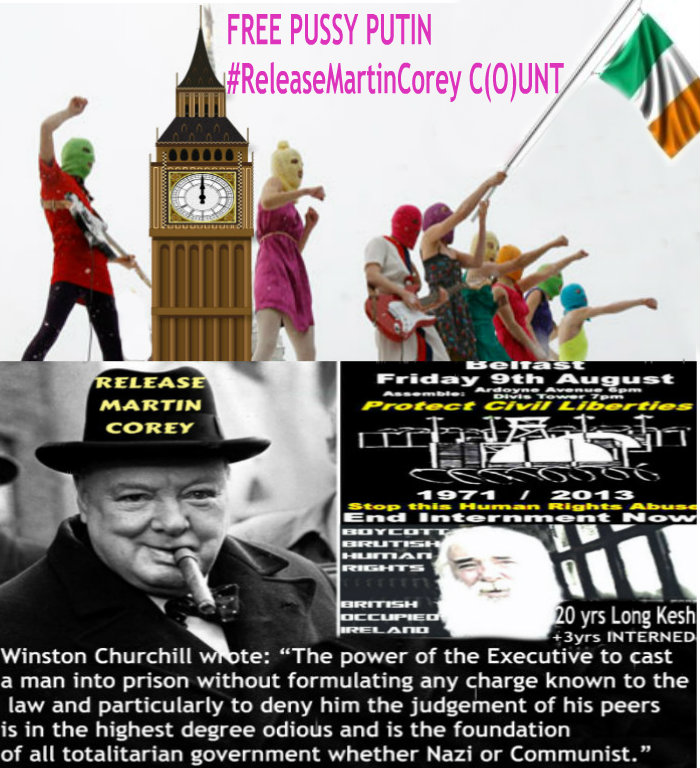
Release Martin Corey
The anti-internment march in Belfast on 9th August 2013, was a welcome display of disciplined unity, against a most serious abuse of human rights, that the establishment parties in Ireland, either wish to ignore or damn with feint protest, while at the same time professing to be democrats, socialists or republicans. Up to 10,000 marchers stewarded by a variety of Irish Republican Socialists, Republicans and human rights organisations, marched from Ardoyne in the north of Belfast, until they they were stopped for approximately 2 hours by PSNI jeeps and thousands of fascist, rioting UVF and Orange Order members near the city centre.
When the human rights marchers pushed their way through the PSNI roadblock, they left the massed riot paramilitary police, with no choice but to clear a route for the protesters, to march through Carrick Hill, before joining with an anti-internment contingent waiting the arrival of comrades at Divis Street. Despite considerable delay, the people of West Belfast lined the march route cheering up to 10,000 anti-internment marchers, making a nonsense of counter revolutionary, press statements and disinformation earlier in the day, bizarrely condemning the 10,000 strong human rights march, as a 'dissident' parade! The march which was lined with well-wishers all along the route, as it made it's way through West Belfast to the Busy Bee Centre, a traditional rallying point for Republicans, where speeches were given by well known human rights figures.
In "THE POLITICS OF INTERNMENT 1971" John McGuffin wrote of the re-introduction of Internment in Occupied Ireland, as follows:
IN the mid-1960's people might have been forgiven for thinking that internment was a thing of the past. (True, the obnoxious Special Powers Acts were still on the Statute Book, but they were in abeyance). Such thinking was not to be right, however. The monolithic structure of Unionism proved incapable of reforming itself under the onslaught of the civil rights campaign. Terence O'Neill might have been able to save the Unionists with his pragmatic approach and his appreciation of the need for change, but their diehard 'not an inch' backwoodsmen would have none of it. And so the week of 12 – 16 August 1969 saw the old familiar pattern: a police force unable, and, in many cases unwilling,[1] to prevent the sectarian attack upon the Falls Road periphery, led in some cases by the B specials. That month was to see house burning, intimidation and murder – ten civilians dead, including a 9-year-old boy asleep in his bed, shot by a high-velocity Browning machine-gun used with murderous recklessness by the police in their Shorland armoured cars; 145 injured, hundreds of families burnt out of their homes, 90% of them Catholic. Free Derry was born that week. The barricades went up in Belfast. The first steps towards the irrevocable demise of Stormont were taken. And, predictably, men were detained, without charge or trial.
At 6.45 a.m. on 14 August, 28 Republicans were arrested and taken from their homes. As usual, no 'Loyalist' extremists or gunmen were arrested.
When the English Special Branch men arrived next month to sort out the RUC they asked for the files on all the 'terrorists'. They were handed the records, mostly out-of-date, on the IRA. "What about the UVF," they asked. "It doesn't exist," was the reply. "We have no records on Loyalists."
But this time it was not to be internment. The British army had had to be called in. Callaghan and Wilson had summoned Chichester Clark to Downing Street. The B men were 'phased out'. The Scarman Tribunal was set up. The Labour Government was tired of the old-fashioned traditional Unionist methods. Moreover, from behind the barricades a campaign was being mounted. Illegal radios proliferated. Street newspapers were born. The detainees were released after 17 to 20 days. The message should have been clear; internment should have no place in the 1970's.
But the Unionist hierarchy learn nothing from history. The gangling figure of Chichester Clark, the stand-in PM, shambled off into obscurity as 1970 and 1971 saw an escalation of the violence by the Provisional IRA, themselves a reaction to the attempted 'Loyalist' pogrom of 1969.
On 23 March 1971 Brian Arthur Deane Faulkner achieved his lifelong ambition and became PM. The English press warned that he was the 'last man in'. If he couldn't control the situation, direct rule was a certainty. But despite the obvious immensity of the task, Faulkner was confident.
This was the moment for which he had schemed, intrigued and betrayed, for so long. With a staggering record of disloyalty to previous PMs, he could hardly expect to be trusted or liked, but surely all could agree on his shrewdness and ability.
In fact, Faulkner's intelligence was always greatly over-rated by the media. And his biggest mistake was soon to come. The Sunday Times 'Insight' team claim[2]that "when he took over the issue was not whether internment was to come, but when and on what scale. By then Faulkner had been an advocate of internment inside Chichester Clark's Joint Security Committee, for six months." Whether this is true or not, and on balance it seems a reasonable statement, it is certain that Faulkner had completely failed to learn the lesson of how and when internment 'worked'. He had been Minister for Home Affairs in 1959 under Brookeborough, and, with the help of his trusty aide, the civil servant William Stout, he bad been responsible for the implementation of internment, which he apparently felt to be responsible for the defeat of the IRA border campaign. As is made clear already, this just was not so. The campaign failed, for lack of popular support, and, most important, the internees could languish in Crumlin because there was no campaign to get them released.
Nevertheless, one of Faulkner's first actions upon becoming Northern Ireland's last PM was to order the RUC Special Branch to work with the Director of Military Intelligence at Lisburn in drawing up a list of those Catholics who should be interned. The army were unhappy. General Tuzo, the GOC in Northern Ireland since February 1971, consistently opposed internment, believing, rightly, as it turned out, that they could not get the right people. But as the violence escalated, Faulkner became more and more insistent. On 9 July he telephoned Heath. "I must be able to intern now" he demanded. Accordingly, with some reluctance, a 'dry run' was agreed upon. At dawn on 23 July, 1,800 troops and RUC raided Republican houses throughout the province, searching for documents. They got enough to encourage them. The decision to intern was only a matter of time then, despite army objections.
The position was complicated by the mistrust and, in some cases, downright hostility between the army and the RUC. As the Sunday Times team put it: "The army believed the police list was politically motivated, and the police believed that the army's list showed inadequate local knowledge." Both were correct. Some sections of the army had favoured a small internment in the spring of 1971, with only 50 or 60 men being lifted. They had been overruled. Now the task was to be much greater.
The list had more than 500 names on it. Of these only 120 or 130 were gunmen or officers in the IRA. The vast majority were regarded either as 'Fellow-travelling sympathisers' or troublesome political activists – like PD socialists. The police contribution was the names and addresses of former internees. But Faulkner was determined. At the Joint Security Committee meeting at Stormont, Shillington, the Chief Constable, agreed with Tuzo that internment would not work. That made no difference. Faulkner secretly flew to London that afternoon. There he convinced the Cabinet. Tuzo could offer no alternative. Maudling was his usual indolent self. Whitelaw said nothing. Internment without trial was acquiesced to.
The date was set for 10 Augnst. On Sunday 7 August, however, Harry Thornton, an innocent building worker, was driving his car past Springfield Road barracks when it backfired. Soldiers opened up and killed him. His friend Murphy was dragged from the car, covered with Thornton's blood, and savagely beaten by police and army. Within minutes the people of Clonard went wild. The fighting went on all night but had died down the next day. But the army were taking no chances. At midnight on Sunday the order went out: operation internment was brought forward 24 hours. Brian Faulkner had unwittingly signed himself his own political death warrant – and that of Stormont, too.
Related Link: http://irishblog-irelandblog.blogspot.com/
Anti Internment Republican March Attacked By Loyalists
Labels:
ACTIVIST,
human rights,
Internment,
Irish,
martin corey,
POLITICAL ASYLUM,
RUSSIA
Location:
Ireland
Thursday, August 15, 2013
PEACE PROCESS IRELAND DEVOID OF DUE PROCESS
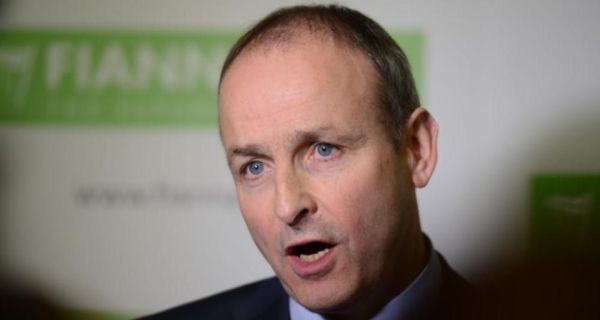
The reason SF and FF split in the first place was the Constitutional issue. PSF surrendered on that matter, so there are now no actual ideological differences.While Martin McGuinness has called De Valera a traitor, for murdering IRA men, he also said Ireland could not be freed without armed struggle. We now have proof that McGuinness is a waffler like Gerry Adams, who says he was never in the IRA and with FF and PSF having 40% of the vote its highly likely that Britain's MI5 will have a major say after the next election and that a United Ireland will rejoin the British Commonwealth. Michael Martin is correct but like Adams he fogets to mention, it is first and foremost devoid of Justice, as in the instance of internment without trial.

Opening the Merriman Summer School in Lisdoonvarna, Co Clare the Fianna Fáil leader said problems in Northern Ireland were being merely “managed” rather than “developed”. Photograph: Alan Betson
The Northern Ireland peace process is devoid of urgency and ambition and run by people who pander to their own constituencies and partisan concerns, Micheál Martin has said.
Opening the Merriman Summer School in Lisdoonvarna, Co Clare, last night, the Fianna Fáil leader said problems in Northern Ireland were being merely “managed” rather than “developed”.
“In some areas we are seeing a slow but undeniable retreat from a policy of deeper co-operation,” he said.
A majority in Northern Ireland felt the Stormont Assembly had achieved little, he said. In the Republic, people paid attention to Northern Ireland only when problems arose.
“There are only a handful of journalists who pay any attention to the wider cultural, social and economic dimensions of relations within Northern Ireland and between North and South,” he said.
“It is as if issues relating to the North have been put away in a file marked ‘history’ only to be dusted off when communal tensions flare up again.”
His address focused on the need for the opportunities provided by the Belfast Agreement to be pursued fully.
“The failure to take all of these opportunities, to build deep understanding of other communities, to aggressively target development, to work to being the concerns of marginalised groups and areas on to a shared agenda – each of these poses a long-term threat to what has been achieved,” he said.
The British-Irish element of the agreement was the most developed, he said, but North- South opportunities were being overlooked.Calling for a “reinvigorated north-south dimension”, he said work was needed to promote development which would show practical results for communities.
His singled out the failure to secure funding for the Narrow Water bridge spanning counties Louth and Down, and called for a range of all-Ireland economic initiatives including a Border Economic Zone.
UNITY: CLOSER THAN ANYONE THINKS
Moya St Leger argues that Irish citizens remain unprepared for unity. It is a slightly modified version of a piece featured in the Irish Democrat on 17 May 2007 Moya St Leger. Connolly Association president 2002-2008.
IRELAND COULD unite within ten years. All the indicators suggest as much. These include the steady demographic shift in the North; the assurance of Her Majesty's Government that Britain has "no selfish strategic or economic interest" in Northern Ireland; the pledge of both the Irish and British governments to support legislation to bring about a united Ireland if both parts of Ireland vote in favour of it, and the fact that political obstacles have been removed to this end.
Yet in the Irish Republic, at home, in the office, on the street, in bars and restaurants, in cabs and buses, not a word is said. Ninety years after the Easter rising - republicans excepted - a nation remains resolutely silent on the one historical imperative for which their forebears fought and died.
There is some talk of a united Ireland in the North but virtually none in the Republic. This has been noted by the Connolly Association. Since an end to partition is closer than it has ever been, in London we have been swapping our own theories on why so few in Ireland wish to comment.
In Dublin recently, a brilliant young film-maker was unequivocal in her view: "United Ireland? You can keep the north. We don't want those troublemakers," she said.
Understandable. Twenty-five years of bombing and shooting in the north caused people in the Republic to draw back in fright and distance themselves from their northern neighbours. Nationalism became associated with violence, so republicans were banned from radio and TV, and military parades at Easter abandoned.
Hostile media coverage of the IRA campaign mimicked the biased reporting in the British media. The representation of the IRA as a bunch of depraved criminals, whose thuggery bore no historical resemblance to the armed struggle of the 'old IRA', suited certain political elements in the Republic who were nervous of Sinn Fein's all-Ireland focus.
The unremitting anti-republicanism of the mainstream Irish media left no room for dispassionate political analysis and debate. The respectful stance of successive Irish governments vis-à-vis Britain persuaded the Irish that any talk of a united Ireland was tantamount to siding with terrorists.
People were led to believe there was a moral gulf between the 'old IRA' who fought in the war of independence and the Provos, as if a fundamentally different moral standard could be applied to the Soloheadbeg ambush of the RIC in 1919 and the mortar attack on the Newry RUC police station in 1979.
This schizophrenic attitude became the default mindset of the majority. It led to reluctance in the south to acknowledge the north as part of a country with shared ancient Irish roots present before the colonial period. A casualty of this disconnection is the younger generation, who grew up with no strong feelings about the border.
Another young Dubliner, an IT consultant, summed it up. "The north isn't our concern. Let the politicians get on with whatever they're doing, we've got better things to do with our time". He admitted to having little interest in Irish history. The tales of a handful of over-nineties reminiscing about the 1920s in country snugs never reached the ears of the Celtic Tiger generation hanging out in their trendy bars in the cities.
Now the Celtic Tiger is dead and the Irish of the Republic have seen their dreams shattered by having blindly nailed the Irish tricolour to the EU mast, Sinn Fein is increasing its TDs in the Dail, and Gerry Adams TD gaining influence in the Republic with his relentless unification campaign. Adams has clearly seen that relying on the Good Friday Agreement to produce constitutional change is not enough.
The under-forties in the Republic cannot empathize with the powerful emotions and zeal which fuelled the war of independence and the civil war. Never having experienced British hegemony, they see no point in challenging the status of the north, even less in discussing it.
Undeterred by the nation's waning interest, Albert Reynolds an astute businessman turned politician, who had never let the border impede his commercial activities, decided the conflict had to end.
By entering into talks with British Prime Minister John Major, the Taoiseach risked his political career in an effort "to overcome the legacy of history and to heal the divisions".
The seismic movement of the political ground triggered by the Reynolds-Major talks resulted in the Downing Street Declaration of 1993. Five years later, the multi-party Good Friday agreement received the consent of 94.39 per cent in the Republic.
Some Protestants in Northern Ireland's business community already locked into the global economy are wondering whether unification would be such a bad thing after all - provided they can keep their British passports!
The grindingly slow process agreed by the British and Irish governments of creating a stable Northern Ireland should not impede a nationwide debate in the whole of Ireland about the country's future. Adams is right to encourage that debate. He of all people knows the British will not discourage it because a national debate within the whole of Ireland accords with the unstated British long view that ultimately sovereignty of the north will have to be surrendered for chiefly economic reasons.
The state visit of the Queen to Ireland in 2011 was no courtesy visit. It signified the Crown's formal acknowledgement of the Irish Republic. One day a British monarch will be signing an Act of Parliament ceding the six remaining northern counties to the Republic. The royal visit of 2011 laid the necessary foundation for that Act of Parliament.
Preparing the ground for a united Ireland is laborious and takes time. The constitutional issues are relatively straightforward, but it is not premature for the Irish people north and south to start talking about the daunting practicalities of unification and, crucially, who will fund it.
Accommodating six extra counties will pose a huge challenge for the Republic's institutions and the British civil servants eventually tasked with cooperation in the process. Public discussion is needed in Ireland on how to tackle uniting the administration, the judiciary, education and local government.
The merging of health care facilities and transport infrastructure, not to mention the replacement of sterling with the Euro (if it still exists) and all that entails, require meticulous forward planning. A national debate requires the input of ideas from professionals in all fields. Germany is still working on overcoming the epic obstacles of its unification 24 years later. It is an ongoing process.
A divided Ireland has not been written in stone and acting as if devolution is the end of the road, while being a diplomatic stance to adopt vis-a-vis. unionists, will not stem the inexorable tide of history.
IRELAND COULD unite within ten years. All the indicators suggest as much. These include the steady demographic shift in the North; the assurance of Her Majesty's Government that Britain has "no selfish strategic or economic interest" in Northern Ireland; the pledge of both the Irish and British governments to support legislation to bring about a united Ireland if both parts of Ireland vote in favour of it, and the fact that political obstacles have been removed to this end.
Yet in the Irish Republic, at home, in the office, on the street, in bars and restaurants, in cabs and buses, not a word is said. Ninety years after the Easter rising - republicans excepted - a nation remains resolutely silent on the one historical imperative for which their forebears fought and died.
There is some talk of a united Ireland in the North but virtually none in the Republic. This has been noted by the Connolly Association. Since an end to partition is closer than it has ever been, in London we have been swapping our own theories on why so few in Ireland wish to comment.
In Dublin recently, a brilliant young film-maker was unequivocal in her view: "United Ireland? You can keep the north. We don't want those troublemakers," she said.
Understandable. Twenty-five years of bombing and shooting in the north caused people in the Republic to draw back in fright and distance themselves from their northern neighbours. Nationalism became associated with violence, so republicans were banned from radio and TV, and military parades at Easter abandoned.
Hostile media coverage of the IRA campaign mimicked the biased reporting in the British media. The representation of the IRA as a bunch of depraved criminals, whose thuggery bore no historical resemblance to the armed struggle of the 'old IRA', suited certain political elements in the Republic who were nervous of Sinn Fein's all-Ireland focus.
The unremitting anti-republicanism of the mainstream Irish media left no room for dispassionate political analysis and debate. The respectful stance of successive Irish governments vis-à-vis Britain persuaded the Irish that any talk of a united Ireland was tantamount to siding with terrorists.
People were led to believe there was a moral gulf between the 'old IRA' who fought in the war of independence and the Provos, as if a fundamentally different moral standard could be applied to the Soloheadbeg ambush of the RIC in 1919 and the mortar attack on the Newry RUC police station in 1979.
This schizophrenic attitude became the default mindset of the majority. It led to reluctance in the south to acknowledge the north as part of a country with shared ancient Irish roots present before the colonial period. A casualty of this disconnection is the younger generation, who grew up with no strong feelings about the border.
Another young Dubliner, an IT consultant, summed it up. "The north isn't our concern. Let the politicians get on with whatever they're doing, we've got better things to do with our time". He admitted to having little interest in Irish history. The tales of a handful of over-nineties reminiscing about the 1920s in country snugs never reached the ears of the Celtic Tiger generation hanging out in their trendy bars in the cities.
Now the Celtic Tiger is dead and the Irish of the Republic have seen their dreams shattered by having blindly nailed the Irish tricolour to the EU mast, Sinn Fein is increasing its TDs in the Dail, and Gerry Adams TD gaining influence in the Republic with his relentless unification campaign. Adams has clearly seen that relying on the Good Friday Agreement to produce constitutional change is not enough.
The under-forties in the Republic cannot empathize with the powerful emotions and zeal which fuelled the war of independence and the civil war. Never having experienced British hegemony, they see no point in challenging the status of the north, even less in discussing it.
Undeterred by the nation's waning interest, Albert Reynolds an astute businessman turned politician, who had never let the border impede his commercial activities, decided the conflict had to end.
By entering into talks with British Prime Minister John Major, the Taoiseach risked his political career in an effort "to overcome the legacy of history and to heal the divisions".
The seismic movement of the political ground triggered by the Reynolds-Major talks resulted in the Downing Street Declaration of 1993. Five years later, the multi-party Good Friday agreement received the consent of 94.39 per cent in the Republic.
Some Protestants in Northern Ireland's business community already locked into the global economy are wondering whether unification would be such a bad thing after all - provided they can keep their British passports!
The grindingly slow process agreed by the British and Irish governments of creating a stable Northern Ireland should not impede a nationwide debate in the whole of Ireland about the country's future. Adams is right to encourage that debate. He of all people knows the British will not discourage it because a national debate within the whole of Ireland accords with the unstated British long view that ultimately sovereignty of the north will have to be surrendered for chiefly economic reasons.
The state visit of the Queen to Ireland in 2011 was no courtesy visit. It signified the Crown's formal acknowledgement of the Irish Republic. One day a British monarch will be signing an Act of Parliament ceding the six remaining northern counties to the Republic. The royal visit of 2011 laid the necessary foundation for that Act of Parliament.
Preparing the ground for a united Ireland is laborious and takes time. The constitutional issues are relatively straightforward, but it is not premature for the Irish people north and south to start talking about the daunting practicalities of unification and, crucially, who will fund it.
Accommodating six extra counties will pose a huge challenge for the Republic's institutions and the British civil servants eventually tasked with cooperation in the process. Public discussion is needed in Ireland on how to tackle uniting the administration, the judiciary, education and local government.
The merging of health care facilities and transport infrastructure, not to mention the replacement of sterling with the Euro (if it still exists) and all that entails, require meticulous forward planning. A national debate requires the input of ideas from professionals in all fields. Germany is still working on overcoming the epic obstacles of its unification 24 years later. It is an ongoing process.
A divided Ireland has not been written in stone and acting as if devolution is the end of the road, while being a diplomatic stance to adopt vis-a-vis. unionists, will not stem the inexorable tide of history.
Posted in: Feature from Elsewhere
Labels:
DEVOID,
Due Process,
Ireland,
Irish,
peace process
Location:
Ireland
Wednesday, July 31, 2013
MARTIN COREY STILL BRITAIN'S ABU GHRAIB IRISH GUINEAPIG
These forms of Irish internment torture, which Britain was found guilty of torture, by the European Court of Human Rights, became known as the 'Five techniques,' which the British promised not to use again but instead they trained American personnel in their application, for use in places like Abu Ghraib later on.
40 years ago Martin Corey was interned in Long Kesh Concentration Camp, with hundreds of felloW Irishmen from all over British Occupied Ireland. Below is an account of what happened subsequently. Martin was released almost 20 years later, only to be interned again, despite a supposed Peace Process, more than 3 years ago without any reason, charge or trial given to him. A judge ordered his release but was overruled by the non-elected English Viceroyal in Ireland. The British were originally taken by the Irish Government to the European Court of Human Rights in Strasbourg and Britain was found guilty of torture. Martin Corey has to go to the European Court again to get a trial as the British won't give him one. The British government is currently considering a withdrawal from the International Human Rights Courts because, they have been found guilty in 3 out of 4 cases of Human Rights Abuse.
"After being hooded I was led to the helicopter and I was thrown bodily into the helicopter. During this exercise my hands and wrists were hurt due to the others handcuffed to me not being pushed equally. (Before being led off to the helicopter, I understand that one of the hooded men, now known to be F. McGuigan, collapsed when the hood was first applied.) On being put into the copter, the handcuffs were removed and were applied to the back of the hood to tighten it around the head. The helicopter took off and a journey which I would estimate to have taken about an hour began. The helicopter than landed at a destination unknown to me and we were taken from the copter and led into a building and eventually into a room where I was made to stand in a search position against a wall. My position was the same as for other men – fully stretched, hands as far apart as humanly possible and feet as far from the wall as possible. Back rigid and head held up. Not allowed to relax any of the joints at all. If any relaxation of limbs – arms, elbow joints, legs, knee joints – someone came along and grabbed the limb in a rough manner and put it back into position again. After being against the wall for a few hours. I was taken away and brought, I was told, to a doctor. Sometime during this period I was taken out of this room, put into a helicopter and flown away. I was always handcuffed and hooded. When the 'copter landed I was put into a lorry, driven a short distance, transferred to a jeep, five-minute journey, put into another 'copter, taken for half-hour journey. End of journey put into a police van, driven short distance, five-ten minutes, beaten about the face and body, transferred to other vehicle. Holding my face, asked why, said that I did not want to be beaten again. Assured that I wouldn't be. Brought into a building, hood removed, shown detention form. Hood replaced, return journey as before
The build-up to this collapse was frequent numbing of the hands which when it happened I closed my fist only to find that my hands were beaten against the wall until I opened my fingers again and put my hands back into position. On the other occasion I tried to rest by leaning my head against the wall but the response to this was my head was 'banged' on the wall and shaken about until I resumed my position. All the time there was the constant whirring noise like a helicopter blades going around. From the sound of this noise I would say that it was played into the room where I was because on the occasions that I was taken from this room even outside the door of the room the noise was noticeably vague almost to be inaudible.
As I have said, I collapsed completely after that long period of time. I was brought round and carried out into the main room again and made resume my position as before against the wall.
There then followed a series of collapses – I could not say how many times I collapsed. Initially my hands and legs were beaten whenever this happened and the insides of my feet were kicked until my ankles were swollen to almost twice their normal size. After a number of these collapsings I was then made sit on the floor, with my knees up to my chest, my head between my knees and my arms folded around my knees. In this position I was swayed backwards and forwards in order I presume to bring my circulation back. Whenever this was done I was put against the wall again in the original position. The noise was insistent, driving mental resistance to its utmost. I thought that I was going mad. This noise was the only noise one heard save the groans of the other people lined up against the wall.
All the time that I was against this wall I got bread and water once and water alone on two other occasions. This was fed to me by the hood being lifted to my nose and bread and water was fed into my mouth in this way. I should emphasize that I was fed, I did not feed myself. The cup of water was put to my mouth and the bread was put into my mouth.
I cannot possibly estimate for what duration I was against this wall and underwent the collapsing experiences and physical torture against this wall, but I would estimate that it must have been at least two full days and nights. During all of the time no sleep was permitted. At the end of the period I must say that I was extremely fatigued both physically and mentally. I was certainly verging on complete mental exhaustion, suffering delusions which were of nightmarish nature.
I was taken out of this room – into another room where my hood was removed and I found myself confronted by two plain-clothes RUC SB men, one of whom was standing beside a table and the other was seated behind it. I was told by these men that I had asked to see them. I do not recollect ever having done so. I told them I did not ask for anyone. They then began to interrogate me. These men did not introduce themselves to me, so I do not know who they were. The hood was removed during this entire interview. These men interrogated me for a couple of hours. I should say that at the start of this interview I imagined that I was talking to my brother. At the end of this interview the hood was put back on again and I was put back into the other room and put against the wall. I asked where I was but I was told that I could not be told.
As I was against the wall this time I was given a beating: kicked about the legs, a knee was stuck in the base of my spine and the hood was jerked back tight on my face, hurting my neck. I collapsed at the end of this beating. I was also punched in the ribs and in the stomach, as well as being nipped. I was brought round after collapsing and put up against the wall again. The nipping and punching on the arms and ribs commenced. At that I shouted Fuck off', and punched one of my assailants. I was then grabbed by a number of people and I was punched, kicked and kneed all over the body, stomach, ribs and back of my head. The hood was pulled tightly around my neck, nearly suffocating me. I was then put back against the wall. After a short time against it I collapsed. I do not know for how long I was out. The next thing that I clearly remember was sitting in this small room with the same two men as before, who again told me that I sent for them. The hood was taken off for this interview as well. This interview lasted only a very short time, a matter of minutes. I was re-hooded and taken out again into another room where I was beaten continuously for a long number of hours. During the beating I was asked questions concerning the IRA, naming various people, and they also asked me about arms dumps. During all of this time I was standing. Due to the beating – mostly about the body and head, not face – I fell unconscious. When I awakened I was lying on a floor and as I was waking I was being punched. During this period of unconsciousness I had a dream where a friend of mine – my fiancee's brother – bought a scrap-yard. Whenever I awoke and found myself being beaten I began to struggle – I kicked one person and punched another. I was then overcome – my hands were put behind my back and I was handcuffed in this position. There was an attempt to handcuff my ankles. I was then carried down a flight of stairs into a further interrogation – by a different person than previously. The hood was taken off. He told me that I had sent for him. I said that I did not but that I had asked for a priest. He told me that I would get no priest there. After a few questions I was re-hooded and led outside and into another room where I was made, hands still handcuffed behind my back, stand facing a wall with the crown of my head leaning against the wall. As I stood there my arms were pulled further back causing my wrists to be cut and torn. I was left alone in this room un-hooded for a few hours. This same SB Branch man came back in but was very gentle in the course of questioning. He would have questioned me for two to three hours. He then left me again alone in the room – this time for about six hours. He returned when it was morning and told me that I was going back in for a few hours. I asked him where and he said, 'to the jail'. He brought me into a washroom and helped me to shave and have a general clean-up. I was then brought to a doctor. I complained to him of dizziness and pain in my right knee. He bandaged it and gave me an examination. Then I was photographed in the nude both front and rear. I was given my clothes back when I got back to the room. I changed and, after about an hour, I was brought now re-hooded to a Land-Rover and then after a short journey of five to ten minutes was put into a 'copter. After about an hour's flying journey we landed. Taken out. I know now that I was landed at the back of the prison (Girdwood). Marched through a hole in a wall. Across a football pitch and then put into a jeep. Driven to a gate – transferred into another police jeep and driven to the prison reception. I asked in the prison reception, where I was weighed etc., what day it was and he told me Tuesday. I said that it couldn't be since I was in Girdwood on Tuesday but he told me that that was a week ago. After going through the formalities of reception I was put into a cell in the basement where I was kept until the following morning when I was transferred to C wing amongst the other detainees. Whilst in the basement I was given a meal – the first substantial food I received in over a week.
European Commission of Human Rights inquiries and findings
The Irish Government, on behalf of the men who had been subject to the five methods, took a case to the European Commission on Human Rights. The Commission stated that it "considered the combined use of the five methods to amount to torture, on the grounds that (1) the intensity of the stress caused by techniques creating sensory deprivation "directly affects the personality physically and mentally"; and "the systematic application of the techniques for the purpose of inducing a person to give information shows a clear resemblance to those methods of systematic torture which have been known over the ages... a modern system of torture falling into the same category as those systems... applied in previous times as a means of obtaining information and confessions" From Wikipaedia
The Guineapigs in the title were fourteen Irish political prisoners on whom the British Army experimented with sensory deprivation torture in 1971. These 'techniques' are now outlawed, following Britain's conviction at the International Court of Human Rights at Strasbourg, but have been exported and used by Britain's allies throughout the world. This book first appeared in 1974, published by Penguin Books in London. It sold out on its first print run and was then abruptly taken off the market following pressure from the British Government.
In Ireland in 1971 there was deliberate and careful use of modern torture techniques, not merely to get information but to perfect the system of Sensory Deprivation for use against civilians. The author, an ex-internee himself spent two years researching the book following his release from Crumlin Road jail where he had been held without charge or trial. In this new edition he is at last able to name the torturers and those responsible for this sordid episode in British Imperial history. No member of the British Army or the Royal Ulster Constabulary has ever been convicted of torture or brutality to prisoners, although the Government has been forced to pay out over $5 million in compensation to torture victims.
This re-issue of 'The Guineapigs' is dedicated to the blanket men in Long Kesh concentration camp and the women political prisoners in Armagh jail. 'Na reabhloidi Abu.'
The Guineapigs
by John McGuffin 1974,
Labels:
Abu Ghraib,
Britain's,
Guineapig,
Irish,
martin corey
Location:
Ireland
Friday, July 26, 2013
TITANIC SINKING IRELAND
The Capitalist Shame of the Titanic
by kswheeler
For many years, this event was not only a tragedy but a travesty. Investigations conducted after the sinking showed that White Star Line stewards kept third-class passengers locked into the lower decks while the available lifeboats (only enough for half the people on board) were loaded with the first- and second-class patrons. The survival rates of the poor on the Titanic were there for all to see: only 25 percent survived, as opposed to 63 percent of first-class passengers.
The Titanic was advertised as the grandest vessel ever built. No luxury was spared, and people clamored for tickets for the maiden voyage. First-class tickets started at $4,300 for the six-day voyage, at a time when an American middle-class family lived comfortably on $800 a year. And the most expensive first-class suites cost approximately $120,000. Part of what the passengers paid for was security: a new design of the lower bulkheads meant that Titanic had less chance of sinking than an ordinary liner of its time, a fact touted by the White Star Line.
The sinking might have been avoided if Bruce Ismay, managing director of the White Star Line, had not ordered the ship to change to top speed on the night of April 14. He wanted to get into New York City a day early to garner more publicity—despite ice warnings on the seas reported earlier in the day. And at least one ice warning received by Titanic was ignored amid the onslaught of first-class telegrams being sent out about on-shore plans.

But one aspect of the Titanic disaster has only recently come to light, and that was a corporate trick monstrous in its callous disregard of its employees. Individual letters sent to crew that survived and to the families of crew members who died informed them that the employee had been fired in the early morning of April 15. The charge was “gross insubordination” for abandoning ship and “disembarking on the high seas.”

Many passenger claims were made against the RMS Titanic after her sinking: claims by individual families for wrongful death; claims by countries such as Belgium for “loss of countrymen,” and claims for jewelry, paintings, U.S. mail, and an automobile.
By firing all of its crew, the corporation did not have to pay wages for the final voyage, pension claims, or any insurance policies of its employees, saving the company thousands and thousands of dollars. It sounds like the kind of heartless strategy that might be used in a massive corporate layoff today, but this happened 100 years ago.
And who these “insubordinate” crew members? They were not saving themselves. Only 214 crew members survived out of the nearly 800 employees on board. The band famously played to the very end; less well known are the boiler-room crew who worked until they drowned in an attempt to keep electricity going so distress messages could be sent out. The ship’s chief baker immediately went to the kitchens and filled sacks with freshly baked bread and other provisions and threw a sack into each poorly equipped lifeboat. Stewardesses ran back and forth looking for the parents of children who had been separated from their families, and finding the children seats on the lifeboats. Second Officer Charles Lightoller personally saved 31 passengers and crew members after the ship sank by organizing them to stand on top of an overturned lifeboat, and then had them all shift their weight at the same time to keep the boat from tipping over. He was the last person to board the Carpathia, staying in the water until he was sure that every lifeboat passenger was saved.

Stunned families, who saw how Ismay was vilified by the press, kept quiet about the shame of the firings, and how the crew members were treated afterward. That might account for the fact that it took so long for this story to emerge.
When the surviving crew members reached New York on the Carpathia, they were penniless because there were no pay packets waiting for them. They had no clothes but their uniforms. Usually, the White Star Line reserved hotel rooms for crew members and then handed out new assignments to return the crew home to England and Ireland. This time, there were no return passages on offer.
Fortunately, Woolworth’s, hearing of the plight of the abandoned crew members, offered them jobs, free meals, and free clothing. Meanwhile, families back home had to scrape together the money for return voyages. And many of these surviving crew members were never able to get jobs on ships again, with the black mark of being fired by White Star on their records.
Labels:
Internment,
Ireland,
Irish,
TITANIC,
TITANIC IRISH SINKING
Location:
Ireland
Subscribe to:
Posts (Atom)


printable version

Digg this
del.icio.us
Furl
Reddit
Technorati
Facebook


View Comments Titles Only
save preference
Comments (2 of 2)
Jump To Comment: 1 2Author of “Enemies of the State,” Gary Murray, who researched Group 13 for a book but was prevented from writing it. During his research, he was dragged into the back of a van, and had a gun stuck to his mouth. He was told, it would be unwise to continue after which he decided to abandon writing the book.
Group 13 evolved from SAS soldiers and British Secret Service operatives, who were given hands on experience in the counter insurgency political laboratory of British Occupied Ireland, from the late nineteen seventies onward. Starting with Fredrick Holroyd, a Captain in British Army Intelligence, who focused on developing informers and human intelligence sources, connected with the IRA. Resulting viscous turf wars between MI5 and MI6, to control the highly lucrative“patch” of British Occupied Ireland complicated matters considerably.
Holroyd shed considerable light on Britain's dirty war and “Shoot to Kill” policies in Occupied Ireland, which resulted in the dysfunctional investigation of senior police officer, John Stalker. This was also covered in the feature film Hidden Agenda.To cover deployment in this politically sensitive area, they disguised themselves as “training teams,” with cover names like, the Royal Engineers, the Four Field Survey Troop, the Military Reconnaissance Force (MRF), and the 14th Intelligence unit.
All were SAS undercover units stationed principally at Castiledillon, Armagh. Right wing groups operating in the shadows of power, planned a right wing coup. These groups some based in Mid- Ulster, were given unofficial political cover for British State Terrorism, by the Tory Government of Margaret Thatcher, others named GB75, organised by David Sterling, founder of the SAS were operating alongside other groups who have close contact with British Secret Services, from which they still receive some unofficial cover.
Another mysterious group called Resistance and Psychological Operations Committee RPOC was based on material researched, during the torture of Martin Corey and his comrades, when tortured during Long Kesh internment in British Occupied Ireland. RPOC was a reflection of the Special Operations Executive SOE, a dirty tricks operation. RPOC have a clandestine underground movement, operating on a nod and a wink of the Conservative government, with forged close links to British Secret Services and also close links with the SAS. Little is known of the Tory SAS’s secret intelligence network, other than being tasked, with protecting the SAS, who’s lives may be under threat, as a result of their activities. The Irish journalist believes a contract has been put out on him, after this SAS secretive group had mopped on another freelance assassination team sent to kill other Irish human rights activists. “Mopping up” meaning killing members of the original assassination squad.
Elements within this group also evolved to become Group 13. Highly unofficial but desirable to players within the Tory government. Responsible for British political assassinations in Occupied Ireland and worldwide they have right wing agenda. The best known being the SAS in a “wet operation” murder of an unarmed IRA unit in Gibraltar, which led to the TV documentary Death on the Rock, based on eye-witnesses who testified, that the three members were gunned down in cold blood, which in the context of what was happening in Ireland during this period, was part of a shoot-to-kill-policy. meant to 'sanitize' the republican movement, prior to negotiations proper. Gene “Chip” Tatum a former CIA operative and former member of the international assassination team Pegasus, targeting influential international politicians and financiers, alleges that the British assassins, operated during the mid-eighties onward, under the direction of a high ranking British government official, who in turn answered only to Thatcher.
Connections between Group Thirteen and the United States intelligence community during the alleged assassination of Vincent Foster, associate and legal adviser to President Clinton, existed around a highly secret US assassination team, operating out of the National Security Agency NSA. This unit is called “I-3,” with the information on this unit, provided by a “former CIA agent with the CIA’s highest security clearance.” The NSA unit just happens to share a common name with “Group 13” and just happens to be in the same business?
Despite all the smoke and mirrors surrounding Group 13, significant information came to light after the Scott Enquiry into arms to Iraq. Gerald James a leading British munitions manufacturer has written of group 13 in his book In the Public Interest, blowing the lid off the British government's arming of Iraq’s Saddam Hussein. James believes his removal from the Board of Astra, was orchestrated by non-executive director Stephan Kock, a self acknowledged former Security and Intelligence officer in the employ of Midland Bank.
In written evidence presented to the House of Commons Trade and Industry Committee, James stated that he was told, that Kock was “… a former head of ‘Group 13.’ The organisation is a hit or contract squad for the Foreign Office and Secret Services.” The Foreign Office draws Group 13 operatives from the SAS and private security firms,” and “It’s duties involve ‘service to the nation.’” Polite language for British State terrorism. Kock had exceptionally senior level contacts inside British intelligence including ready access to the highest levels of the British government, including the British Prime Minister.
Dr. Gerald Bull - designer of the Supergun , who was shot outside his apartment in Brussels, a few months before his assassination, writing to a colleague, stated he was “advised in a letter of an imminent accident.” He identified the origin of the threat as being the British Foreign Office. This then is the background of the application to Russia for political asylum by the Irish journalist.
Under Article 14 of the Universal Declaration of Human Rights which states that "Everyone has the right to seek and to enjoy in other countries asylum from persecution." The United Nations 1951 Convention Relating to the Status of Refugees and the 1967 Protocol Relating to the Status of Refugees guides national legislation concerning political asylum. Under these agreements, a refugee is a person who is outside their own country's territory owing to fear of persecution on protected grounds. Protected grounds include race, caste, nationality, religion, political opinions and membership and/or participation in any particular social group or social activities. Rendering true victims of persecution to their persecutor is a particularly odious violation of a principle called non-refoulement, part of the customary and trucial Law of Nations.These are the accepted terms and criteria as principles and a fundamental part in the 1951 United Nations Convention Relating to the Status of Refugees non-refoulement order
Unofficially he has been told that it is expected he will be allowed a temporary Russian visa while an asylum application is formally considered. Hopefully,Vladimir Putin will refuse to hand him over to the British.The Irish journalist hopes to make a permanent home in Nicaragua, in South America but the UK has ordered all countries to hand him over to the UK. In order to get asylum, the journalist has to prove a well-founded fear, which in his case means he has at least a 10 percent chance of being murdered by the British, for highlighting the Human Rights Abuse of internment without trial in British Occupied Ireland.
Then he has to give an account of political opinion, race, religion, nationality or group membership. In the case of political opinion, it will in his case be as a human rights activist, in the Police Dictatorship and British State Terrorism of British Occupied Ireland, where political assassination or internment without trial, are regularly used, against all Irish political dissidents of conscience. Several other countries including Spain, Ireland and Ecuador, have said that his asylum requests can’t be processed, because he is presently not in their country currently. However he feels that Group 13 operate openly there anyway. On Friday Daniel Ortega looked like the best option. However currently Russia offer superior quality Human Rights, despite the imprisonment of Pussy Riot. along with having considerably more diplomatic clout than the British, who besides interning Irish political prisoners of conscience, have also kidnapped international whistle blowers of war crimes, such as Julian Assange.
It's the first time I've ever heard of them (by that particular name).
"It is the number that carries the most occult significance. Throughout Europe it has historically been regarded as an ill omen. In Norse mythology, the number 13 often signifies death. Today, in the United Kingdom, there exists a paramilitary unit called Group13. The sole purpose of this ultra secretive unit is deniable assassination and it operates in the world of shadows. So little is known about them, that it is exceptionally hard to document its activities with any certainty."
The above excerpt has come from:
http://www.deepblacklies.co.uk/group_13.htm
Google List #1:
"British paramilitary unit called Group 13 ..."
http://tinyurl.com/ma8puoh
Google List #2:
"Murder of Human Rights Lawyers Pat Finucane and Rosemary Nelson, government corruption, crime, cover ups, and IMPUNITY, Ireland ..."
http://tinyurl.com/kuv6ynp
=== === ===