Showing posts with label Hunger Strike. Show all posts

Tuesday, May 21, 2013

OGLACH RAYMOND McCREESH


Died May 21st, 1981
A quiet, good-natured and discreet republican
The third of the resolutely determined IRA Volunteers to join the H-Block hunger strike for political status was twenty-four-year-old Raymond McCreesh, from Camlough in South Armagh: a quiet, shy and good-humoured republican, who although captured at the early age of nineteen, along with two other Volunteers in a British army ambush, had already almost three years active republican involvement behind him.
During those years he had established himself as one of the most dedicated and invaluable republican activists in that part of the six counties to which the Brits themselves have – half-fearfully, half-respectfully – given the name ‘bandit country’ and which has become a living legend in republican circles, during the present war, for the courage and resourcefulness of its Volunteers: the border land of South Armagh.
Raymond’s resolve to hunger strike to the death, to secure the prisoners’ five demands was indicated in a smuggled-out letter written by Paddy Quinn, an H-Block blanket man – who was later to embark on hunger strike himself – who was captured along with Raymond and who received the same fourteen year sentence: “I wrote Raymie a couple of letters before he went to the prison hospital. He wrote back and according to the letter he was in great spirits and very determined. A sign of that determination was the way he finished off by saying: Ta seans ann go mbeidh me abhaile rombat a chara’ which means: There is a chance that I’ll be home before you, my friend!”
Captured in June 1976, and sentenced in March 1977, when he refused to recognise the court, Raymond would have been due for release in about two years’ time had he not embarked on his principled protest for political status, which led him, ultimately, to hunger strike.
FAMILY
Raymond Peter McCreesh, the seventh in a family of eight children, was born in a small semi-detached house at St. Malachy’s Park, Camlough – where the family still live – on February 25th, 1957.
The McCreeshes, a nationalist family in a staunchly nationalist area, have been rooted in South Armagh for seven generations, and both Raymond’s parents – James aged 65, a retired local council worker, and Susan (whose maiden name is Quigley), aged 60 – come from the nearby townland of Dorsey.
Raymond was a quiet but very lively person, very good-natured and – like other members of his family – extremely witty. Not the sort of person who would push himself forward if he was in a crowd, and indeed often rather a shy person in his personal relationships until he got to know a person well. Nevertheless, in his republican capacity he was known as a capable, dedicated and totally committed Volunteer who could show leadership and aggression where necessary.
Among both his family and his republican associates, Raymond was renowned for his laughter and for “always having a wee smile on him”. His sense of humour remained even during his four-year incarceration in the H-Blocks, as well as during his hunger strike where he continued to insist that he was “just fine.”
SCHOOL
Raymond went first to Camlough primary school, and then to St. Coleman’s college in Newry. It was at St. Coleman’s that Raymond met Danny McGuinness, also from Camlough, and the two became steadfast friends. They later became republican comrades, and Danny too then a nineteen-year-old student who had just completed his ‘A’ levels was captured along with Raymond and Paddy Quinn, and is now in the H-Blocks.
At school, Raymond’s strongest interest was in Irish language and Irish history, and he read widely in those subjects. His understanding of Irish history led him to a fervently nationalist outlook, and he was regarded as a ‘hothead’ in his history classes, and as being generally “very conscious of his Irishness”.
He was also a sportsman, and played under-sixteen and Minor football for Carrickcruppin Gaelic football club as well as taking a keen interest in the local youth club where he played basketball and pool, and was regarded a good snooker player.
When he was fourteen years old, Raymond got a weekend job working on a milk round through the South Armagh border area, around Mullaghbawn and Dromintee. Later on, after leaving his job in Lisburn, he worked full-time on the milk round, where he would always stop and chat to customers. He became a great favourite amongst them and many enquired about him long after he left the round.
RESISTANCE
During the early ‘seventies, the South Armagh border area was the stamping ground of the British army’s Parachute regiment, operating out of Bessbrook camp less than two miles from Raymond’s home. Stories of their widespread brutality and harassment of local people abound, and built-up then a degree of resentment and resistance amongst most of the nationalist population that is seen to this day.
The SAS terror regiment began operating in this area in large numbers too, in a vain attempt to counter republican successes, and the high level of assassinations of local people on both sides of the South Armagh border, notably three members of the Reavey family in 1975, was believed locally to have been the work both of the SAS, and of UDR and RUC members holding dual membership with ‘illegal’ loyalist paramilitary organisations.
Given this scenario and Raymond’s understanding of Irish history, it is small wonder that he became involved in the republican struggle.
JOINED
He first of all joined na Fianna Eireann early in 1973 and towards the end of that year joined the Irish Republican Army’s 1st Battalion, South Armagh.
Even before joining the IRA, and despite his very young age, Raymond – with remarkable awareness and maturity – became one of the first Volunteers in the South Armagh area to adopt a very low, security conscious, republican profile.
He rarely drank, but if occasionally in a pub he would not discuss either politics or his own activities, and he rarely attended demonstrations or indeed anything which would have brought him to the attention of the enemy.
It was because of this remarkable self-discipline and discretion that during his years of intense republican involvement Raymond was never once arrested or even held for screening in the North, and only twice held briefly in the South.
Consequently, Raymond was never obliged to go ‘on the run’, continuing to live at home until the evening of his capture, and always careful not to cause his family any concern or alarm.
Fitted in with his republican activities Raymond would relax by going to dances or by going to watch football matches at weekends.
WORK
After leaving school he spent a year at Newry technical college studying fabrication engineering, and afterwards got a job at Gambler Simms (Steel) Ltd. in Lisburn. He had a conscientious approach to his craft but was obliged to leave after a year because of a fear of assassination.
Each day he travelled to work from Newry, in a bus along with four or five mates who had got jobs there too from the technical college, but the prevailing high level of sectarian assassinations, and the suspicion justifiably felt of the predominantly loyalist work-force at Gambler Simms, made Raymond, and many other nationalist workers, decide that travelling such a regular route through loyalist country side was simply too risky.
So, after leaving the Lisburn factory, Raymond began to work full-time as a milk roundsman, an occupation which would greatly have increased his knowledge of the surrounding countryside, as well as enabling him to observe the movements of British army patrols and any other untoward activity in the area.
ACTIVITY
Republican activity in that area during those years consisted largely of landmine attacks and ambushes on enemy patrols.
Raymond had the reputation of a republican who was very keen to suggest and take part in operations, almost invariably working in his own, extremely tight, active service unit, though occasionally, when requested – as he frequently was – assisting other units in neighbouring areas with specific operations. He would always carefully consider the pros and cons of any operation, and would never panic or lose his nerve.
In undertaking the hunger strike, Raymond gave the matter the same careful consideration he would have expended on a military operation, he undertook nothing either a rush, or for bluff.
CAPTURE
The operation which led to the capture of Raymond, his boyhood friend, Danny McGuiness, and Patrick Quinn, took place on June 25th, 1976.
An active service unit comprising these three and a fourth Volunteer arrived in a commandeered car at a farmyard in the town land of Sturgan a mile from Camlough – at about 9.25 p.m.
Their objective was to ambush a covert Brit observation post which they had located opposite the Mountain House Inn, on the main Newry – Newtonhamilton Road, half-a-mile away. They were not aware, however, that another covert British observation post, on a steep hillside half-a-mile away, had already spotted the four masked, uniformed and armed Volunteers, clearly visible below them, and that radioed helicopter reinforcements were already closing in.
As the fourth Volunteer drove the commandeered car down the road to the agreed ambush point, to act as a lure for the Brits, the other three moved down the hedgeline of the fields, into position. The fourth Volunteer, however, as he returned, as arranged, to rejoin his comrades, spotted the British Paratroopers on the hillside closing in on his unsuspecting friends and, although armed only with a short range Stengun, opened fire to warn the others.
Immediately, the Brits opened fire with SLRs and light machine-guns, churning up the ground around the Volunteers with hundreds of rounds, firing indiscriminately into the nearby farmhouse and two vehicles parked outside, and killing a grazing cow!
The fourth Volunteer was struck by three bullets, in the leg, arm and chest, but managed to crawl away and to elude the massive follow up search, escaping safely – though seriously injured – the following day.
Raymond and Paddy Quinn ran zig-zag across open fields to a nearby house, under fire all this time, intending to commandeer a car. Unfortunately, the car belonging to the occupants of the house was parked at a neighbour’s house several hundred yards away. Even then the pair might have escaped but that they delayed several minutes waiting for their comrade, Danny McGuinness, who however had got separated from them and had taken cover in a disused quarry outhouse (where he was captured in a follow-up operation the next day).
The house in which Raymond and Paddy took cover was immediately besieged by berserk Paratroopers who riddled the house with bullets. Even when the two Volunteers surrendered, after the arrival of a local priest, and came out through the front door with their hands up, the Paras opened fire again and the Pair were forced to retreat back into the house.
On the arrival of the RUC, the two Volunteers again surrendered and were taken to Bessbrook barracks where they were questioned and beaten for three days before being charged.
REMARKABLE
One remarkable aspect of the British ambush concerns the role of Lance-Corporal David Jones, a member of the 3rd Battalion, the Parachute regiment. According to Brit statements at the trial it was he who first opened up on the IRA active service unit from the hillside.
Nine months later, on March 16th, 1977 two IRA Volunteers encountered two Paratroopers (at the time seconded to the SAS) in a field outside Maghera in South Derry. In the ensuing gun battle, one SAS man was shot dead, and one IRA Volunteer was captured. The Volunteer’s name was Francis Hughes, the dead Brit was Lance-Corporal David Jones of the Parachute regiment.
In the eighteen months before going on hunger strike together neither Raymond McCreesh or Francis Hughes were aware of what would seem to have been an ironic but supremely fitting example of republican solidarity!
After nine months remand in Crumlin Road jail, Raymond was tried and convicted in March 1977, of attempting to kill Brits, possession of a Garand rifle and ammunition, and IRA membership. He received a fourteen-year sentence, and lesser concurrent sentences, after refusing to recognise the court.
In the H-Blocks he immediately joined the blanket protest, and so determined was his resistance to criminalisation that he refused to take his monthly visits for four years, right up until he informed his family of his decision to go on hunger strike on February 15th, this year. He also refused to send out monthly letters, writing only smuggled ‘communications’ to his family and friends.
The only member of his family to see him at all during those four years in Long Kesh two or three times – was his brother, Fr. Brian McCreesh, who occasionally says Mass in the H-Blocks.
HUNGER STRIKE
Like Francis Hughes, Raymond volunteered for the earlier hunger strike, and, when he was not chosen among the first seven, took part in the four-day hunger strike by thirty republicans until the hunger strike ended on December 18th, last year.
Speaking to his brother, Malachy, shortly after Bobby Sands death, Raymond said what a great loss had been felt by the other hunger strikers, but it had made them more determined than ever.
And still managing to keep his spirits up, when told of his brother, Fr. Brian, campaigning for him on rally platforms, Raymond joked: “He’ll probably get excommunicated for it.”
To Britain’s eternal shame, the sombre half-prediction made by Raymond to his friend Paddy Quinn – Ta seans ann go mbeid me abhaile rombat – became a grim reality. Bhi se. Raymond died at 2.11 a.m. on Thursday May 21st, 1981, after 61 days on hunger strike.

‘HIGH LEVEL’ COLLUSION ADMITTED

cameronfinucane.jpg
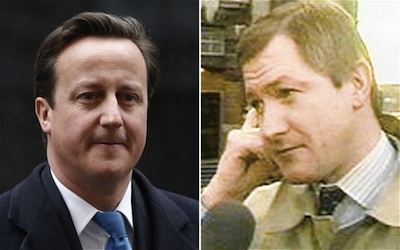
Senior British government officials permitted a campaign of state-backed killings by unionist paramilitaries and the RUC (now PSNI) police to be conducted at the height of the conflict, a senior security adviser for the British government has finally admitted.
The admission in advice to British Prime Minister David Cameron comes after the Downing Street continues to block a genuine inquiry into the 1989 murder of Pat Finucane, a US congressional committee was told on Wednesday.
The point-blank assassination of the Belfast lawyer, who was gunned down in front of his wife and children as he ate his Sunday dinner, remains one of the most controversial state killings in the North.
Last year, Cameron made an apology in the British parliament to the Finucane family, admitting “shocking” collusion in his murder between Loyalist paramilitaries and the RUC. However, he denied any political conspiracy existed, while refusing a public inquiry which could have exposed that claim as false.
However, a letter written in July 2011 by senior official Ciaran Martin admits that internal classified documents supported the Finucane family’s claims.
“[S]ome of the evidence available only internally could be read to suggest that within government at a high level this systematic problem with loyalist agents was known, but nothing was done about it,” said the letter.
“It’s also potentially the case that credible suspicions of agent involvement in Mr Finucane’s murder were made known at senior levels after it and that nothing was done; the agents remained in place. These two points essentially aren’t public.”
Mr Cameron was accused of perpetuating a “massive injustice” for his continued refusal to allow a public inquiry or to admit that the collusion was politically sanctioned.In a hearing in Washington DC this week, Mr Cameron was accused of seeking to protect politicians and senior British government officials who had turned a blind eye to the murder.
Chris Smith, chair of the human rights sub-committee of the House Committee on Foreign Affairs castigated him for its refusal to allow a full inquiry.
“The British government has reserved one final, yet massive injustice,” he said, “it continues to protect those responsible for the murder of Pat Finucane.”
Mr Finucane’s son, Michael, told the committee that he believed the collusion with unionist paramilitaries “was a deep-rooted, officially sanctioned policy of selecting targets based on their degree of opposition to the State.
“The more troublesome the individual, the more likely the State was to deploy its killers-by-proxy to erase the ‘problem’.”
The British government had first offered a public inquiry into his father’s killing in 2001 during peace talks but then consistently “welshed” on the commitment, Mr Finucane said.
In 2004, a review by Canadian Supreme Court Justice Peter Cory called for a public inquiry, but after repeated delays the British government agreed in 2011 only to a’review’ of the case papers.
“My family would not be permitted to see any of the documents nor would we be allowed to hear witnesses called to give evidence or ask them any questions,” said Mr Finucane, arguing that the review was totally inadequate and repeating calls for a full judicial inquiry.
The existence of the security letter first emerged last month at a Belfast High Court hearing challenging Downing Street’s decision not to allow a full inquiry.
The judge ordered the government to hand over minutes of the July 2011 cabinet meeting at which the decision was taken to deny a public inquiry, and correspondence between Downing Street officials and MI5. It is still unclear whether the documents will actually be made available to the Finucane family.
© 2013 Irish Republican News
Wednesday, May 1, 2013

THE POLITICAL RAPE OF MARIAN PRICE


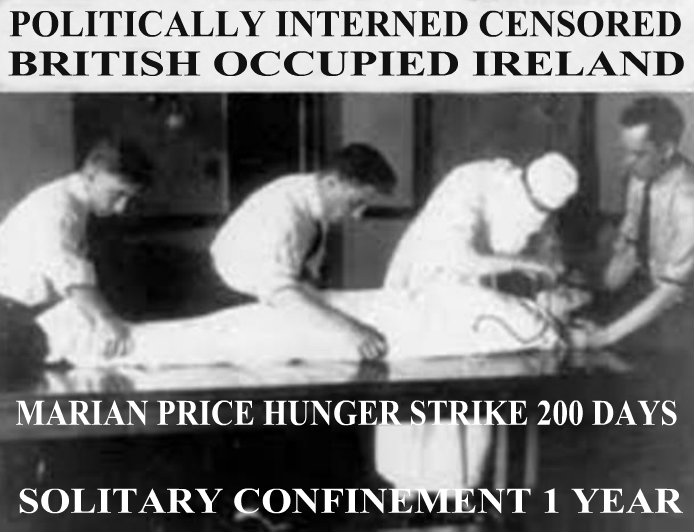
"Four male prison officers tie you into the chair so tightly with
sheets you can't struggle," says Price. "You clench your teeth to try
to keep your mouth closed but they push a metal spring device around
your jaw to prise it open.

"They force a wooden clamp with a hole in the middle into your mouth.
Then, they insert a big rubber tube down that. They hold your head
back. You can't move.

"They throw whatever they like into the food mixer - orange juice,
soup, or cartons of cream if they want to beef up the calories. They
take jugs of this gruel from the food mixer and pour it into a funnel
attached to the tube.

"The force-feeding takes 15 minutes but it feels like forever. You're
in control of nothing. You're terrified the food will go down the
wrong way and you won't be able to let them know because you can't
speak or move. You're frightened you'll choke to death."

Price was force-fed 400 times over six months. "I knew nothing about
force-feeding beforehand," says Price. "I thought it was like when
you hold a baby's nose and put a spoon in its mouth. Ignorance was
bliss."

Marian Price still politically interned 40 years later in British Occupied Ireland, in a supposed Peace Process without Due Process.Her sister Dolours died from the effects of 200 days on hunger strike. Please reshare or retweet to overcome censorship.


Saturday, April 13, 2013

HUNGER STRIKE Goebbels Still Alive


Goebbels is Still Alive


Goebbels is Still Alive

s


Goebbels rose to power in 1933 with Hitler and the Nazi Party and was appointed Propaganda Minister. His first acts was the burning of books. He exercised totalitarian control over the media, arts and information in Germany.

In November 1938, Goebbels got the chance to take decisive action against the Jews for which he had been waiting when a Jewish youth, Herschel Grynszpan, shot a German diplomat in Paris, Ernst vom Rath, in revenge for the deportation of his family to Poland and the persecution of German Jews generally. On 9 November, the evening vom Rath died of his wounds, Goebbels was at the Bürgerbräu Keller in Munich with Hitler, celebrating the anniversary of the 1923 Beer Hall Putsch with a large crowd of veteran Nazis. Goebbels told Hitler that "spontaneous" anti-Jewish violence had already broken out in German cities. When Hitler said he approved of what was happening, Goebbels took this as authorization to organise a nationwide pogrom against the Jews. He wrote in his diary:


Hitler decides: demonstrations should be allowed to continue. The police should be withdrawn. For once the Jews should get the feel of popular anger ... I immediately gave the necessary instructions to the police and the Party. Then I briefly spoke in that vein to the Party leadership. Stormy applause. All are instantly at the phones. Now people will act.
The result of Goebbels' incitement was Kristallnacht, the "Night of Broken Glass," during which the S.A. and Nazi Party went on a rampage of anti-Jewish violence and destruction, killing at least 90 and maybe as many as 200 people, destroying over a thousand synagogues and hundreds of Jewish businesses and homes, and dragging some 30,000 Jews off to concentration camps, where at least another thousand died before the remainder were released after several months of brutal treatment. The longer-term effect was to drive 80,000 Jews to emigrate, most leaving behind all their property in their desperation to escape. Foreign opinion reacted with horror, bringing to a sudden end the climate of appeasement of Nazi Germany in the western democracies. Goebbels' pogrom thus moved Germany significantly closer to war, at a time when rearmament was still far from complete. Göring and some other Nazi leaders were furious at Goebbels' actions, about which they had not been consulted. Goebbels, however, was delighted. "As was to be expected, the entire nation is in uproar," he wrote. "This is one dead man who is costing the Jews dear. Our darling Jews will think twice in future before gunning down German diplomats."

The concentration camps invented by the British followed. From Paelstine to Guantanomo to British Occupied Ireland , Goebbels is alive and well still torturing worldwide today. After World War 2 people worldwide asked how did the German people stand idly by and let it happen. Our children will ask the same questions about us today. What are YOU doing today?


Hunger Strike at Gitmo: ‘We Are Dying a Slow Death Here’
By Pardiss Kebriaei
April 13, 2013 "Information Clearing House" -"MSNBC" -  I’ve just returned from Guantanamo, where my clients and a majority of the other 166 men there have been on hunger strike for over two months. Most of them have been cleared for release or will never be charged. But the Obama administration has refused to send them home.
I met with men who are weak and have lost between 30 and 40 pounds. They told me of other men who are skeletal and barely moving, who have coughed up blood, passed out, and one who tried to hang himself.
One of the men I met with, Sabry Mohammed, a Yemeni who remains detained years after he was approved for release by the Obama administration, said, “We are dying a slow death here.” Yet the authorities say they will not let men die–they will force-feed them when their body weight drops dangerously low, strapping them into chairs and forcing a tube up their noses that pumps formula into their stomachs. The military reports that so far, 11 men are being “saved” this way. Yet as one of the men put it, the irony is that “the government will keep us alive by force-feeding us but they will let us die by detaining us forever.”
Today, 166 men remain at Guantanamo, more than eleven years after they arrived in hoods and shackles. Most are being held without charge and will never be charged. The Obama administration has approved more than half of the men–86–for transfer, but hasn’t mustered the political will to overcome congressional hurdles, despite saying it can and will. As their indefinite detention stretches into a second decade, men are aging, declining and dying. Last September, Adnan Latif, a husband and a father, a man twice cleared for transfer under the Bush and Obama administrations, was the ninth prisoner to die. The current crisis at the base had specific triggers, but there has been an emergency at Guantanamo for years.
The strike was sparked in early February, when prison authorities ordered searches of the men’s Qurans. One man told me, “I won’t even touch the Quran without washing my hands, how could I use it to hide something dirty?” The men viewed the searches as desecration, which should hardly have been news to those in charge. A former Muslim chaplain at Guantanamo once described the handling of the holy books as “the most contentious issue” at the prison. Given the sensitivity of the practice and the history of religious abuse at Guantanamo–acts like throwing Qurans on the ground and shaving detainees’ beards as punishment–the authorities should have known better. Indeed, former commanders did know better. In a 2009 review of conditions at Guantanamo, ordered by the Obama administration, a commander at the base recognized that standard operating procedures “do not permit searching of the Koran.” The rule reflected an “elevated respect” for detainees’ religious concerns–a lesson learned from the early years. It is unclear why that changed. Another of my clients said, “They are taking the camp back to 2006.”
So far, prison authorities have defended their actions and downplayed the scale of the strike. Inside the prison, my clients have described various tactics used to make life even more difficult and break the strike. Some have been life-threatening, like delaying the delivery of filtered drinking water, forcing detainees to drink from the tap of sink faucets attached to toilets in their cells. Before, there used to be signs above the sinks saying it was not safe to drink the water. One man said he would rather go without water than drink from the sink.
As the strike enters its third month and the crisis deepens, the authorities must reach for a resolution before someone dies. My clients are asking for assurances that their Qurans will not be searched, or to hand them in altogether rather than see them desecrated.
But the solution to the broader calamity is closing Guantanamo, beginning with the release of men like Sabry. He told me he does not want to die, he wants to return to his family, but he and others are continuing the strike because they have been pushed too far and this is the only means they have to protest peacefully. The only thing they can control is their own bodies. It is an act of strength even as they are growing weaker. They are desperately wanting to believe there is still a life for them beyond the prison walls.
At the end of our meeting last week, Sabry showed me a painting he made recently, of the prison surrounded by mountains.  But outside the high, tight-mesh fence that encloses Camp 6, where Sabry is held, there is ocean. “I don’t know what is outside. It is just what I imagine.”  After more than eleven years, it is long past time for the United States to send Sabry home.
Pardiss Kebriaei is a senior attorney at the Center for Constitutional Rights who represents men detained at Guantanamo. She is lead counsel for CCR on the targeted killing case, Al-Aulaqi v. Panetta.
What's your response? -  Scroll down to add / read comments 
Email Newsletter icon, E-mail Newsletter icon, Email List icon, E-mail List iconSign up for our FREE Daily Email Newsletter 
For Email Marketing you can trust
  Support Information Clearing House
Monthly Subscription To Information Clearing House


We are testing a new comment software and would appreciate your opinion. Please click here
Please read our  Comment Policy before posting -


3 comments
Livefyre
4 people listening
deleted_13240322_Bill Duke


Brian Clarke


Brian Clarke
We emphathize strongly in Ireland with this hunger strike. People do not undertake such a matter, without a serious injustice being the cause. We can but try to publicize such a tragic human event.The British are also using the 9/11 narrative for torture and injustice in British Occupied Ireland currently.  
The film Hunger portrays events around the last Irish hungerstrike rather accurately and well http://youtu.be/NLw1QcaxIwo. Our country has lost 22 young men and Britain has currently got its own gitmo in Ireland , the most well known being Marian Price who was force fed for over 200 days by the British imperialists and is currently interned for the last 2 years without trial. Interment without trial or (cmps - secret trials)) are been misused using the 9/11 narrative as justification.
Solidarity and salutation to all these innocent internees and hunger strikers from all freedom loving Irish people throughout the world.
Tiocfaidh Ar La - Irish for - Our Day Will Come by Bobby Sands

Saturday, December 1, 2012

MARIAN PRICE HUNGER STRIKE


In an interview with Suzanne Breen, Marian Price described being force-fed:
Four male prison officers tie you so tightly can't struggle. You clench your teeth to try to keep your mouth closed but they push a metal spring device around your jaw to prise it open. They force a wooden clamp with a hole in the middle into your mouth. Then, they insert a big rubber tube down that. They hold your head back. You can't move. They throw whatever they like into the food mixer – orange juice, soup, or cartons of cream if they want to beef up the calories. They take jugs of this gruel from the food mixer and pour it into a funnel attached to the tube. The force-feeding takes 15 minutes but it feels like forever. You're in control of nothing. You're terrified the food will go down the wrong way and you won't be able to let them know because you can't speak or move. You're frightened you'll choke to death.


The English term "concentration camp" was first used widely during the second Boer war(1899–1902), when the British created camps in South Africa for interning the local Boers.They built a total of 45 camps for Boer internees and 64 for black Africans. Of the 28,000 Boer men captured as prisoners of war. The British sent 25,630 captured internee men overseas. The vast majority of Boers who remained in the local camps were women and children. The Nazis in Germany built their concentration camps to British specifications.


Seven year old Lizzie van Zyl murdered in a British Concetration Camp


Britain the Creator of Concentration Camps

The Random House Dictionary defines "concentration camp" as: "a guarded compound for the detention or imprisonment of aliens, members of ethnic minorities, political opponents, etc.", and the American Heritage Dictionary defines it as: "A camp where civilians, enemy aliens, political prisoners, and sometimes prisoners of war are detained and confined, typically under harsh conditions."

Britain deliberately incarcerated and starved the white and black population of South Africa to death in concentration camps. They created inhumane, torturous  conditions in the concentration camps that bred diseases, which spread like wildfire.  In the end, Britain tortured 22,074 white children to death in their camps like seven year old Lizzie van Zyl, (above) - black children excluded(they didn't count black).  They also claimed the lives of 5,898 Boer women —  the number of male prisoners of war, and black men and women excluded. 

Britain murdered and tortured to death more than 70,000  white, and an unknown number of black South Africans in this so-called ‘white man’s war.’  Ordinary farmers and their African helpers, women, the elderly, children and countless livestock all suffered together and died under the heel of the mighty British Empire.  However, Queen Elizabeth still refuses to apologize not mentioning their atrocious war crimes in South Africa!


Marian Price Hunger Strike CENSORED BY INDYMEDIA IRELAND

category international | rights and freedoms | opinion/analysis author Saturday December 01, 2012 18:21author by BrianClarkeNUJ - AllVoices Report this post to the editors
CENSORSHIT IS FASCISM
Marian Price hunger strike censored by Indymedia Ireland. Politically interned, censored in British Occupied Ireland. In solitary confinement one year, interned 19 months without trial. Force fed 200 days.
Marian Price Hunger Strike
In an interview with Suzanne Breen, Marian Price described being force-fed:
Four male prison officers tie you so tightly can't struggle. You clench your teeth to try to keep your mouth closed but they push a metal spring device around your jaw to prise it open. They force a wooden clamp with a hole in the middle into your mouth. Then, they insert a big rubber tube down that. They hold your head back. You can't move. They throw whatever they like into the food mixer – orange juice, soup, or cartons of cream if they want to beef up the calories. They take jugs of this gruel from the food mixer and pour it into a funnel attached to the tube. The force-feeding takes 15 minutes but it feels like forever. You're in control of nothing. You're terrified the food will go down the wrong way and you won't be able to let them know because you can't speak or move. You're frightened you'll choke to death.

The English term "concentration camp" was first used widely during the second Boer war(1899–1902), when the British created camps in South Africa for interning the local Boers.They built a total of 45 camps for Boer internees and 64 for black Africans. Of the 28,000 Boer men captured as prisoners of war. The British sent 25,630 captured internee men overseas. The vast majority of Boers who remained in the local camps were women and children. The Nazis in Germany built their concentration camps to British specifications.

Seven year old Lizzie van Zyl murdered in a British Concetration Camp

Britain the Creator of Concentration Camps

The Random House Dictionary defines "concentration camp" as: "a guarded compound for the detention or imprisonment of aliens, members of ethnic minorities, political opponents, etc.", and the American Heritage Dictionary defines it as: "A camp where civilians, enemy aliens, political prisoners, and sometimes prisoners of war are detained and confined, typically under harsh conditions."

Britain deliberately incarcerated and starved the white and black population of South Africa to death in concentration camps. They created inhumane, torturous conditions in the concentration camps that bred diseases, which spread like wildfire. In the end, Britain tortured 22,074 white children to death in their camps like seven year old Lizzie van Zyl, (above) - black children excluded(they didn't count black). They also claimed the lives of 5,898 Boer women — the number of male prisoners of war, and black men and women excluded.

Britain murdered and tortured to death more than 70,000 white, and an unknown number of black South Africans in this so-called ‘white man’s war.’ Ordinary farmers and their African helpers, women, the elderly, children and countless livestock all suffered together and died under the heel of the mighty British Empire. However, Queen Elizabeth still refuses to apologize not mentioning their atrocious war crimes in South Africa!
Related Link: http://irishblog-irelandblog.blogspot.com/
No Time for Love

Tuesday, June 19, 2012

UNREPENTANT FENIAN BASTARD


Martin Galvin's speech at a commemoration for Brendan Hughes in County Louth.

An influential New York radio program, Radio Free Eireann, where Brendan Hughes’ voice was often heard, begins each week with a song that shouts the words “unrepentant Fenian bastard!” Years ago when first I came across the phrase “unrepentant” Fenian or “unrepentant” Republican, it puzzled me. Repentance to me meant remorse and contrition for some wrongdoing that one later comes to regret.

We mark Easter as our national day to honour Ireland’s patriot dead and pay tribute to their unbroken bond with the volunteers of 1916 by reading the Proclamation. That generation honoured the Fenians, whose very graves they said, guaranteed that” Ireland unfree shall never be at peace.” Later the word Fenian came to be commonly used as a label to abuse any defiant Republicans who did not bend the knee to British rule or the beneficiaries of sectarian privilege. 

Either way I took the term to be a compliment, high praise, and another way of saying Irish patriot. No one speaks of a repentant patriot. Why should any Fenian or Republican be repentant and why would it ever be noteworthy to single out any Fenian for being unrepentant? Of course it is easier to see the meaning today. 

Brendan Hughes surely lived and died as an unrepentant Fenian. He could have no more repented, nor disowned, nor denied his part in the IRA’s fight against British rule, than he could repent being Irish, or disown Belfast, or disavow the legitimacy of the Irish struggle by donning a British criminal uniform in the H-blocks of Long Kesh.

The very suggestion that he repent, disown or even minimize his part in the struggle to make himself more politically acceptable to the British, much less to a Paisley or Robinson led Stormont, would have been answered with that sly mischievous grin, perhaps a chuckle and an instruction to ”cop yourself on.”

Last week David Cameron managed to take time out from his busy schedule with more important matters, to visit what he repeatedly and deliberately calls “this part of the United Kingdom”. He patted himself on the back for the Bloody Sunday families’ hard won apology, said he did it to close the chapter, and spoke of honouring those who he says served with distinction in upholding British rule and law. There does not seem to be much repentance there for the Ballymurphy Massacre, or shoot-to-kill, or internment, or collusion murders with loyalist death squads, or torture or Hunger Strike deaths, Diplock Courts or any of the many other unjustified and unjustifiable acts, mere tactics, wielded in the name of British law and rule. His arrogance is of course in line with what Republicans have always heard from the British crown. Cameron by the way was applauded at Stormont.

Brendan Hughes took pride in counting himself as one of those men and women who” served with distinction” standing against these unjustified and unjustifiable acts committed by those upholding British rule and law, and against the very idea that the right of Irish people to national freedom vanishes into the air a few miles from here. 

It should hardly be necessary for me to speak about his part in the struggle in the presence of some who were with him, with him in the streets of Belfast or the infamous H-blocks of Long Kesh.

However some mention must be made if only because some, in the name of the new political dispensation, seem to believe that it is permissible to dispense with the reputations and role played in the struggle of those like Brendan, who did not fall in line behind the narrative. Our presence here today, the memorial lecture of a few weeks ago, the murals of him, so fittingly near murals dedicated to Republican political prisoners, are proof if any were needed, that Brendan Hughes is beyond any attempt to discredit, diminish or dispense with his exploits. 

Like countless others, I knew of him long before I would meet him. Like a Jim Lynagh, or Pete Ryan or Francis Hughes among so many others, Brendan Hughes was one of those volunteer IRA soldiers whose courage and determination seemed to overflow into those alongside them, somehow instilling confidence that the overwhelming military advantages held by British crown forces would someone be neutralized or overcome because he was there.

He was fearless, a leader who was there at the beginning in Belfast, rose through the ranks, and led from the front. He saw family members killed, faced imprisonment and was not deterred.

It was perhaps most characteristic of him that when he escaped from a British prison he did so not to gain safety in the south or even a respite, but to get back to Belfast and the fight within days.

In the H-blocks he had the unenviable, if not near impossible task of rallying the H-block blanketmen, the 300 Spartans, as Richard O’Rawe described them, keeping up their spirits and morale in the daily fight against British criminalization while at the same time, exercising the restraint and patience required by the Republican movement, to build the campaign which would eventually inspire countless thousands across Ireland and across the globe to rally behind the blanketmen against Thatcher’s brutal torture.

When all attempts at a political resolution, including that by Cardinal O’Fiaich were dismissed by Thatcher, and the ultimate protest, hunger strike, was forced upon Republican political prisoners, Brendan Hughes volunteered to lead. While himself suffering 53 days of hunger strike, on the back of years of protest, the responsibility fell upon him to end the first hunger strike in time to save the life of Sean McKenna. We would then see Thatcher throw away still another opportunity to resolve the protest, instead choosing tactics which would mean the death of ten hunger strike martyrs, in her vain effort to break the struggle by breaking the prisoners.

After his release from Long Kesh, Brendan volunteered to come to the United States to collect funds for the Republican Movement. It was not an assignment he relished, but one that was important to the struggle. He would begin meetings by explaining he was not there to seek monies for Irish Northern Aid or the families of political prisoners or even for Sinn Fein. He was raising money for the IRA.

He threw himself into the tour, meeting small groups answering questions and explaining strategy. He worked with patience, determination and some humor and succeeded nearly doubling his original goal. He was perhaps too successful. It is perhaps no coincidence, that when he returned to Ireland he was slotted into the IRA’s security department, where he could be checked by at least one prominent British agent, Freddie Scappaticci, while another paid British traitor, Denis Donaldson would be posted to New York the next year where he could knock down all that Brendan had built up.

In those days, the British trumpeted the propaganda fiction that the IRA fight was not due to the injustice of British rule but because so-called godfathers were profiting from the war. Anyone who ever visited Brendan Hughes would see this claim for the lie that it was, as he clearly never asked or accepted any profit, from a struggle in which he had given years of his life.

Later, he would come to question a deal that he feared would not only barter away acceptance of British rule and a unionist veto, but would hijack Republicanism,- maneuvering some well-meaning Republicans into positions within a British Stormont administration or constabulary boards where they inescapably would be used by the British to put a Republican front on British rule.

How easy it would have been for him to keep silent, perhaps be seen at the odd political event or commemoration and simply enjoy the prominence, fame and opportunities, which his part in the struggle might have merited. Instead the same beliefs which brought this Unrepentant Fenian out onto the streets of Belfast to join the struggle against the forces of the British crown now led him to decide that loyalty to the struggle demanded he speak against the deal, and direction in which the Movement was headed.

His arguments were seldom answered on the merits but sidestepped with fanciful claims that Brendan was affected by the hunger strike or his years of imprisonment. The worst and most hurtful of these was the slander that he was against the leadership on a personal basis. This was a movement led by some with whom he had fought alongside, been imprisoned and risked his life. The idea of speaking against a leadership which included such close friends must have been heartbreaking for him and harder in some ways than refusing the crown uniform in Long Kesh. Such slanders were created to enable others to justify themselves to themselves without dealing with the truth behind his words.

He became a rallying point for debate, for independent Republican analysis, and for legitimate criticism at a time when many who could never be intimidated into talking at Castlereagh were intimidated into silence by threats, pickets, slurs or ostracism so strong that it could push a strong individual like Whitey Bradley to take his own life.

Today it is important to return to the fundamental question of that debate. Is this Stormont deal a transition to a united Ireland? Will accepting British rule, taking Stormont ministries or places on constabulary boards, and banding together in partnership with the DUP, succeed in removing the injustices underpinning British rule, overcoming the unionist veto and uniting Ireland?

Or was the deal planned by the British to be a final resting place for Republicans? Will those who become wedded to a British administration ultimately be wedded to its injustices- their very presence and reputations as Republicans trotted out to present visible Republican faces behind which British rule will be administered in British interests? Will those from the unionist community be swayed to join them in a united Ireland or is it more likely that some from the nationalist community, who take up jobs and positions, begin to think that British rule is not so bad for me? 

We need only look to Maghaberry, and the plight of Republican prisoners which was always so close to Brendan’s heart. Thirty years ago, Republicans were in the midst of a Hunger Strike in Long Kesh.

It had been forced on the prisoners by years of beatings and “naked brutality”, much of inflicted during mirror searches of naked prisoners. The British crown indulged the sectarian brutality and beatings because it served British objectives. Forcing Republican prisoners to wear a criminal uniform was part of a strategy, to claim the six counties as normal, and claim those in Long Kesh or Armagh as criminals duly convicted by Diplock courts. 

Many who supported these Republican prisoners, Cardinal O’Fiaich first and foremost, did not support the armed struggle, but did so a humanitarian basis, noting that the Blanketmen were jailed under special laws, by special Diplock Courts, for unselfish politically motivated actions that would never have occurred except for the political situation. Which of these criteria does not apply to Republican political prisoners in Maghaberry today?

Why cannot Sinn Fein on this same basis halt this naked brutality and secure the enforcement of the reasonable agreement made last August 12? 

Why today in Maghaberry under a compromised justice ministry, and handpicked minister, is this brutality allowed to continue? 

Why do we hear DUP members and David Ford sounding Thatcher like in saying no concessions and Sinn Fein unable or unwilling to halt this naked brutality?

Marian Price is also in Maghaberry, not for anything she said or did at an Easter Commemoration in Derry, (although the day when it is illegal to commemorate Easter and its meaning in the six counties may be coming .She is there because a British official arbitrarily revoked her decades old license.

One of those then charged with her, has a top position at Stormont and on the constabulary board. Does that make her situation better or worse? When will she have an opportunity to challenge the crown’s use of a license as a license to intern at will? 

Gerry McGeough is also in Maghaberry. He was jailed in 2011 for IRA charges that took place in the middle of the 1981 Hunger Strike. We know he was arrested in retaliation for running for election as an Independent Republican and criticizing a re-branded crown constabulary. How many members of the crown forces have been give a silent amnesty for shoot-to-kill, collusion murders, or even torture or perjury in cover-ups.

How can Republicans look at cases like this and not question whether seats at Stormont or constabulary boards are leading only to more seats at Stormont or more places at boards serving British rule in a partitioned Ireland. 

Again last week, Cameron was at Stormont. His speech should have shattered the myths and illusions. He thinks it is done and dusted. He thinks when we speak of Ireland and unification we should be speaking of the north cemented together with England, Scotland and Wales. He thinks that the British crown has at last locked up movement towards Irish freedom within Stormont, as tightly as Brendan Hughes and the three hundred Spartans were locked away in Long Kesh. He was even applauded by Sinn Fein.

How many times did his predecessor, Thatcher think that she had Brendan Hughes and the blanketmen beaten? How wrong she was.

Brendan Hughes and his fellow political prisoners locked away in the H-blocks or Armagh were able to inspire a unity and determination which broke anything that Thatcher or the British could throw at them. Can Republicans today forge a unity and strategy which can break through once more, and get us back on the path to the united and free Ireland which this unrepentant Fenian and so many others sacrificed and suffered so much to win for us?