Showing posts with label riots. Show all posts

Thursday, September 6, 2012

Farcical Charges Against Marian Price Again


Farcical Charges Against Marian Price Again !

category international | rights and freedoms | news report author Thursday September 06, 2012 07:44author by BrianClarkeNUJ - AllVoices Report this post to the editors
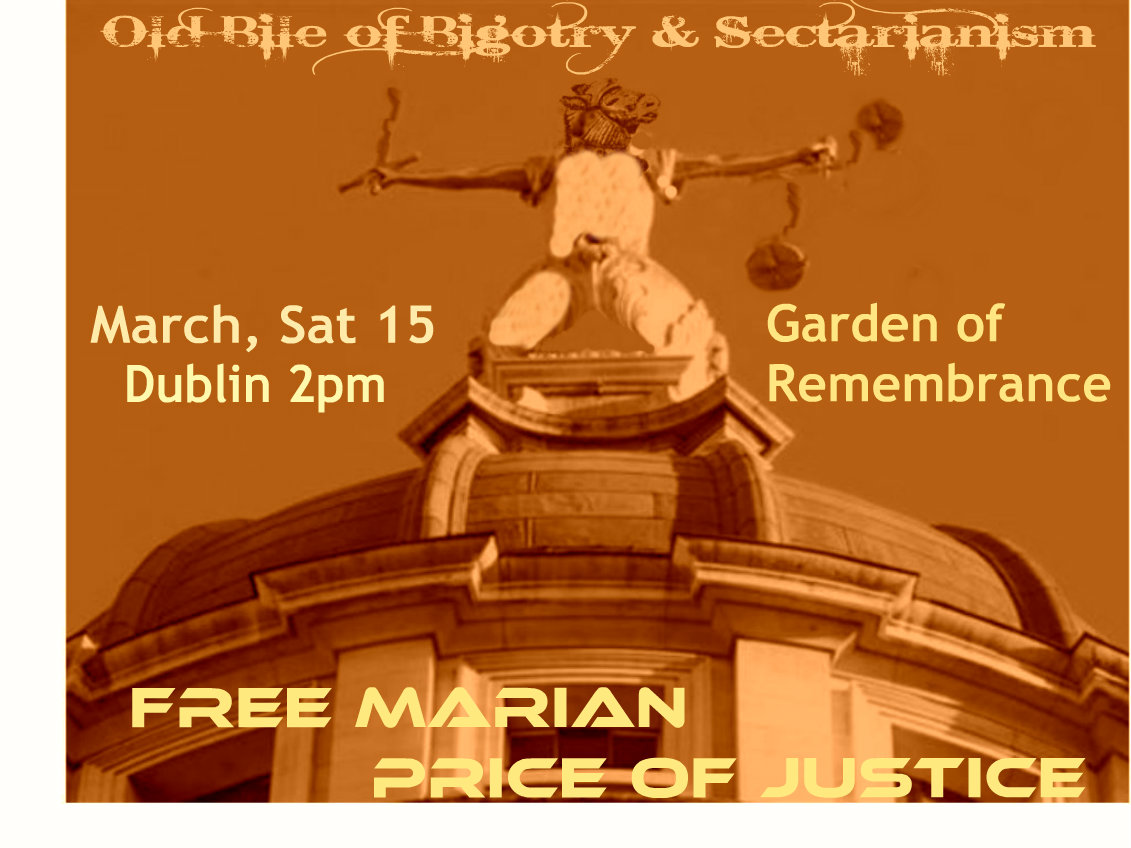
Ant-Internment March, Sat 15 at 2 pm, Garden of Remembrance, Dublin
Farcical charges ahead of an anti-internment March in Dublin, have been re-instated by the British against Marian Price again, creating further internment again by remand. Charges previously thrown out of court by a judge and dismissed against four people, including former hunger striker Marian Price have been re-instated by the Public Prosecution Service of British Occupied Ireland. Marian Price's lawyer said she was seriously ill and may not be fit to appear in court.The charges relate to a traditional Easter republican ceremony in Derry in April 2011.
British Law in Ireland is a Farse
In May, a judge dismissed the charges and said he would not return the four for trial as there were "no papers in front of him" and the charges were not proceeded with. However farcically the decision by the PPS means that the four will now face the original charges again and be on remand for yet many more years as a result. Three Derry men were freed but Ms Price continued to be held interned without trial.

Ms Price, under her married name of Marian McGlinchey was charged after holding up a piece of paper on a windy day at the ceremony, along with Paddy McDaid, 42, of Sackville Court, Frank Quigley, 29, of Elmwood Road and Marvin Canning, 50, of Glendara, all of Derry with taking part in a meeting in support of a proscribed organisation.They are due to appear in a preliminary enquiry at the city's Magistrate's Court on 27 September.

At the time of her first appearance on this charge in May 2011, it was announced that the secretary of state had revoked Ms Price's licence and she has remained interned ever since. Her licence was revoked by the British Vice royal Owen Paterson who was ordered back to England on Tuesday and is to be replaced Theresa Villiers MP who is direct descendant of George William Frederick Villiers (1800-1870), Fourth Earl of Clarendon, c. 1864 who served as Lord Lieutenant of Ireland 1847–52 during the Irish holocaust

The 44-year-old divorcee from Barnet in London takes over as British Direct Ruler following several nights of parades-related
sectarian loyalist rioting in north Belfast.Ms Villiers is a brother of the 4th 'Earl of Clarendon' George Villiers and has represented the constituency of Chipping Barnet, situated between Hertfordshire and Finchley in north London, since 2005.

She is a former barrister with an interest in aviation, and served in Tory leader David Cameron's shadow cabinet before being named Minister of State for Transport in 2010. While Villiers is a relative unknown in Ireland, the departure of Paterson, who becomes Cameron's Minister for the Environment, Food and Rural Affairs, will be welcomed. Detested among all people of justice and Irish republicans, Paterson will always be identified with the re-introduction of selective internment without trial, as well as
the criminalisation of Irish political prisoners.His high-handed British rule coupled with internment made him a highly unpopular figure across the political divide in Ireland.

The appointment of Villiers, the first woman in the post since the relatively more reasonable Mo Mowlam, may bring a more human outlook to British rule in Occupied Ireland and boost hopes for peace however with recent events, it is becoming clearer that justice is not possible in the sectarian statelet for ordinary Irish working people or people of no property. Villiers has a royal 'true blue' Tory background and is unlikely to help resolve sectarian problems created by her predecessors, resulting in riots and intimidation.

The Loyalist UVF and UDA orchestrated clashes with the detested PSNI in the Carlisle Circus/Denmark Street area of Belfast. The PSNI used water cannon and fired plastic bullets on the Loyalist rioters placing more pressure on the Parades Commission
ahead of a giant sectarian parade planned later this month. The article below explains the saga of the long running debacle of the internment without trial of Marian Price and the type of British injustice feeding the violence, that poisons young Irish minds and hearts with injustice.

What Civil Rights ?
"The accumulation of all powers, legislative, executive, and judiciary, in the same hands ... is the definition of tyranny."

- James Madison

The power of the Executive to cast a man into prison without formulating any charge known to the law, and particularly to deny him the judgment of his peers, is in the highest degree odious and is the foundation of all totalitarian government whether Nazi or Communist.

Winston Churchill as, In The Highest Degree Odious : Detention Without Trial in Wartime Britain by A. W. B. Simpson

Dublin Sept 15th at 2pm, Garden of Remembrance Free Marian Price

Forty years ago Marian Price marched for civil rights, with her friend Moira Drumm in British Occupied Ireland after being inspired by the Black Civil Rights movement lead by Martin Luther King in the US. Over 40 year later on a windy day, she reached up and held a script, to prevent it being blown away, while a masked man read the traditional IRA’s “Easter Message.” She was arrested on May 13th 2011 and charged with encouraging support of an illegal organisation. Marian appeared three days later in court in Derry, where she was granted bail but as she left the courthouse, she was re-arrested, as per order of a document, signed by the Vice royal Owen Paterson and taken to high-security, solitary confinement in the all male Maghaberry jail. The court case was meaningless, because Paterson’s contempt for justice and due process was trumped by his order to override the bail decision of the Judiciary.

Now, as a result of sensory deprivation torture, she is seriously ill and has been transferred to a Belfast hospital, like her former friend Moira Drumm whom the British shot dead in a Belfast hospital many years ago. Marian is under armed guard with locked bolted doors, barred windows and under 24 hour surveillance. She is gravely ill with pneumonia, while probably being held until she dies in one way or another. Paterson’s order for Marian to effectively die in a British prison, was based on “intelligence” information from his secret services, who have a vested interest in the internment of traditional Irish republicans and political dissidents.

In July, Marian was then charged with “providing property for the purposes of terrorism” allegedly having bought a mobile phone which the British maintained was subsequently used in the killing of two British soldiers at Massereene barracks, back in early 2009. Marian was held then, for two days, questioned about this specific allegation, before being released without charge. No evidence was found in the interim or proffered to the court on this matter. The Judge looking at precisely the same lack of evidence, again granted Marian bail. But yet again as she left the court, another unelected vice royal Paterson order, took precedence over the judge and the court.The Massereene charge was meant to discredit her and associate her with the shootings to undermine a public campaign for her release which attracted considerable support, from people not politically aligned, who could not fathom what crime she had actually been committed, at the traditional Easter Commemoration. Since then the British have orchestrated several personal whispering campaigns, against Marian and her supporters.

A year after her original arrest, the charges relating to the commemoration were thrown out of a Derry court by the judge, who was told, preliminary papers were still not ready. Judge McElholm declared every citizen was entitled to a fair trial, in a reasonable period and that the British had clearly not met this criteria. But again Marian was imprisoned by an order from Paterson. This was the third time a court ordered her released and the third time the unelected English Vice royal in British Occupied Ireland, overruled the court and said no. Further to overruling the judiciary, he also overruled his own Queen. Marian Price was previously given a full royal pardon by the Queen of England or the royal Prerogative of Mercy.Cardinal O'Fiach the head of the Catholic Church bore witness to the fact. Vice royal Paterson again claimed that this document, which would set Marian free, had been lost or shredded by his colleagues. This is a rather serious matter, because perverting the course of justice, is a very serious matter carrying a life in prison for ordinary mortals.

Patrick Ramsey, a Social Democratic Labour member of the elected British Assembly recently wrote to Paterson about this "lost" pardon and formally asked;

-- Where would Mrs. Price-McGlinchey's pardon have been held?

-- How many staff are currently seeking the document and in what departments?

-- Are those looking for it doing so on a full-time basis, if not, why not?

-- Has the Northern Ireland Office received comment from the judiciary on the apparent loss of the document?

-- How many Royal Prerogative's have been lost (or destroyed) that the government has record of?

-- Who is ultimately responsible for the care and maintenance of the building where these documents are kept?

-- What communication [has Paterson] personally had with this person/Department?

-- Can [Paterson] confirm the Department is still seeking the document and will do so until it is found?

Again the unelected English Vice royal Paterson in Ireland contemptuously dismissed the elected Irish Assembly member Ramsey's inquiry, stating that "unfortunately the Royal Prerogative of Mercy was not recovered but had no bearing on current circumstances. Patterson has now even gone further and is now demanding, the local elected Assembly be downsized and it's 'peace process' structures be dismantled.

The UN Special Rapporteur on Torture, Juan Mendez and two leading criminologists, Dr. Phil Scraton of Queen’s University and Dr. Linda Moore of the University of Ulster, have visited Marian with all three calling for her release both on the grounds of her civil rights, basic due process and for humanitarian health reasons before she dies. Both academics and authors of several official reports on prisons in Occupied Ireland, stated: “Given the concerns expressed locally and internationally regarding her continued detention and declining health, we urge you to release her on humanitarian grounds. Marian Price has been imprisoned…without trial in circumstances which may amount to administrative internment and which we believe to be in breach of the European Convention on Human Rights.”

Vice royal Paterson the horsey blood sport enthusiast, married into British royalty, sniffed his stiff Tory upper lip and overruled their recommendation once again. Internment without trail, like all things experimented with in British Occupied Ireland, in the last 40 years of British war on the Irish people, is now being introduced in England itself. While Patterson was overruling his British judiciary and Queen, his Tory party colleagues are introducing a Bill to give it's Ministers power, to use secret service gestapo evidence in secrecy, under “Closed Material Procedures.” Such evidence would not be produced in court, for “national security” reasons, preventing even the accused, the right of defence or the right to know what charge exactly is being made against them..

When Marian was 19, she was one of nine members of the Provisional IRA, who planted four bombs in London, which included the Old Bailey almost 40 years ago in March 1973. Despite a two hour warning, a man died from a heart attack. The IRA team, included Gerry Kelly now a Minister at the Stormont parliament and she was also under orders of several current leading Irish politicians, involved in the peace process, a peace process undermining justification for huge secret service, British taxpayers budgets in Ireland. Marian Price was freed more than 30 years ago in 1980, suffering from tuberculosis, anorexia and weighing just five stone. She and her sister Dolours spent 200 days on hunger strike, demanding political status. They were force-fed three times a day for 167 of the 200 days, with a tube forced down their the throats into their stomach, which almost murdered Marian several times. The resulting trauma and psychological damage of ongoing torture then and now, led to a 1980 royal pardon because of imminent death.

Marian has insisted from the moment arrested in May last year, that she was released in 1980 on a Royal Prerogative of Mercy, which Paterson does not have the authority to override. Paterson claims its terms, which he has not seen, authorizes him to override his queen. Marian's lawyers have repeatedly asked that the pardon be produced, so the terms can be checked by a judge. One does not have to be particularly bright, cynical or subjective, listening to the contradictions in Patterson's waffle subsequently, to conclude who precisely should be spending the rest of their life in prison for perverting the course of justice in British Occupied Ireland. The cause of peace in Ireland is not served by the denial of justice. The only cause served by keeping Marian Price and other political prisoners of conscience interned without a proper trial Maghaberry, is the cause and coffers of the bloated secret service British taxpayers budgets. There is a call for those who genuinely want peace in Ireland, to work for justice and protest in Dublin on Sept 15th at 2pm, from the Garden of Remembrance.

Related Link: http://irishblog-irelandblog.blogspot.com/
Related Link: http://irishblog-brianclarkenuj.blogspot.com/
47 PSNI Officers Injured In Loyalist North Belfast Riots (2/9/12)

Wednesday, July 18, 2012

UK Riots 2011 London 2012 Olympics !


Return of anti-Irish racism in Britain

Tuesday, July 17th, 2012 at 5:14 pm
BRIAN WHELAN

Poster advertising Saturday's "anti-IRA" march in Liverpool
Last week saw the announcement of an “anti-IRA” march in Liverpool by hardline English Defence League splinter group the North West Infidels (NWI), a  far-right street protest movement. The march is an anachronism, a feeble attempt by the far-right to relive past ‘glories’ – but if you scratch beneath the surface of English society anti-Irish prejudice still lurks.
Thousands of Irish people have emigrated to England over the last three years. They’ve arrived in the country with over 600,000 Irish born citizens, but are quite often completely unaware of the difficulties past generations faced moving here.
Occasionally you may notice the signs of a previous tension; a total stranger might approach you in the pub upon hearing your accent to let you know their relative was killed while serving in the North, as if you were to blame or should apologise.
For me the soft face of anti-Irish sentiment first hit home when people began to leave comments under articles I’ve written suggesting it’s time for me to move home and hand my job and house over to a British person. I felt it was my own fault for venturing below the line.

Poster advertising Saturday's march
It turns out I’m not alone. British-born journalist Brendan O’Neill regularly receives “Paddy-bashing’” abuse for simply having an Irish surname and occasionally speaking out against “Catholic-bashing”.
This Saturday Liverpool’s Irish community had planned to march against racism.  The event is organised by the James Larkin Society with the hope of countering the worrying rise in far-right activity targeting Muslims, trade unionists and Irish republican groups living in the north of England.
Outraged by the prospect the North West Infidels have called for their own protest billed as “Stop the IRA march in Liverpool”, despite the event having nothing to do with the IRA.
The poster in red, white and blue boldly declares: “Over the past several years the city of liverpool and north west england has seen the rise of anti-British feeling projected on them by immigrant families from the republic of Ireland.”
The rhetoric is laughable, but it’s being backed up with physical force.
“These people are much like the Islamics. They take take take with one hand and abuse their host nation with the other. They openly support sinn fien [sic] and the irish republican army and we are expected to stand by, smile and allow them to spread the hatred for britain.”
Last February, in scenes unseen since the 80s, hardline British nationalists stopped a march commemorating Liverpool-born Republican Sean Phelan and racially abused marchers.
The NWI, usually dedicated to harassing the Muslim community under the pretence of protesting “extremism”, have openly expanded their remit to include targeting Irish families.
Any sane English person would stay away, as the protest represents something abhorrent to right-minded people, and while most Irish immigrants have no interest taking part in an anti-racism protest or republican commemoration, even a fringe re-emergence of anti-Irish street marches should come as a warning to us all.
The rhetoric of groups like the English Defence League is just the recycled racism of the 1980s when the National Front and British Movement would stage “anti-IRA” marches as an excuse to attack and intimidate Irish immigrants. As a consequence many Irish people moved to the forefront of the fight against the far-right in the UK and played a central role in beating the fascists off the streets.
The unspoken rule seems to be that Irish people are white, so discriminating against them can’t be racist. When BBC3 screened RTE’s documentary about Irish rappers last week the soft face of anti-Irish prejudice quickly surfaced on Twitter:
“You should be Happy They Spitting Bars and Not Blowing up Sh*t#IRA
“Irish rappers on bbc three!? Give it a rest, f**k off back to the fiddle and flute you potato eating chumps!“
“Irish rappers!!…potato famine has resulted in some damage chromosomes me thinks”
Similar Tweets about any other nationality could potentially get the person arrested or fired from their job, but when the jokes are aimed at the Irish it is written off as “banter”.

Brian Whelan
This is a situation helped by our love of self-deprecation and general thick-skinned nature when taking criticism, but outbursts like the above should not be tolerated. It’s up to us to decide when the joke stops.
The recession has scattered an entire generation of Irish youth across the globe, hopeful and idealistic, but ultimately abandoned by our own government and without any networks for support. While the French government has created new constituencies abroad to represent their expats, Ireland withdraws support closing the RTE London office at a time when more Irish people here need a voice than ever before.
A fractured Irish community with no connection between the old generation and the new arrivals can make an easy target. Without a sense of our own history anti-Irish sentiment might seem like something that doesn’t affect you, but if left unchecked it could come marching down your street next.
Brian Whelan is an Irish journalist living in London. He blogs atbrianwhelan.net and Tweets at @brianwhelanhack.

Saturday, July 14, 2012

OLYMPRIC RIOTS START IN BELFAST : Irish Republican News


 IRISH REPUBLICAN NEWS
    http://republican-news.org

    Friday-Thursday, 6-12 July, 2012


1.  PARADE CHAOS IN BELFAST
2.  Legal turmoil as Martin Corey's bail release overturned
3.  Problems mount for Boston College journalists
4.  Violence follows 'Eleventh Night' bonfires
5.  Attempt to recuit informer at Derry hospital
6.  Minister shamed over private hospital deal
7.  Feature: Remembering Martin Hurson
8.  Analysis: Price and Corey prisoners of MI5-spun web of deceit


-----------------------------------------------------------------------


>>>>>> PARADE CHAOS IN BELFAST


 The sound of gunfire echoed across north Belfast on Thursday night
 following disturbances over an incendiary and bitterly opposed sectarian
 parade.

 The route through nationalist north Belfast had been forcibly cleared by
 the PSNI, who beat and shoved residents away from the parade route
 before the first march took place in the morning.

 The parade through the Catholic Ardoyne area was one of hundreds held on
 Thursday by the Protestant Orange Order to mark a 17th century
 Protestant battle victory over Catholics.

 Serious trouble broke out immediately after the 'return' parade passed
 at around 4.30pm.  One vehicle was burned out and some petrol bombs
 thrown. An unknown number of plastic bullets were fired by the PSNI
 police while water cannon was also used as clashes broke out.

 Members of local residents group, the Greater Ardoyne Residents
 Collective (GARC) appealed for calm, and rioting ebbed briefly as a
 pre-planned protest by GARC then took place along the same road which
 the Orangemen had just marched down.

 However, loyalists (including some known paramilitaries) who had
 gathered just meters away immediately rioted and violently attacked the
 GARC protest.

 As events deteriorated, fireworks, petrol bombs, stones, bricks and
 bottles were hurled at police lines, while a second blazing car was
 driven up to create a second barricade.  At one point, armoured PSNI
 vehicles were driven at speed through the streets in an apparent attempt
 to clear the area. A blast bomb was thrown at the PSNI vehicles, while
 one protestor was reported to have suffered a severe beating at the
 hands of the police.

 Serious disturbances continued in the Brompton Park area of north
 Belfast late into the night. The PSNI confirmed reports of at least ten
 gunshots as trouble intensifed, but said there were no injuries.

 Trouble also broke out in other areas. Disturbances in Craigavon saw a
 bus set ablaze. In the Bogside area of Derry, rioting continued into the
 early hours of the morning with at least one car burned out, while
 petrol bombs and stones were thrown at the PSNI. There were reports that
 the home of the new Sinn Fein Mayor of Derry, Kevin Campbell, was among
 those raided by the PSNI overnight.

 Expectations of violence had increased during the week following
 criticism by unionist leaders over the conditions placed on the Orange
 parade in Ardoyne. In particular, they vehemently opposed a decision by
 the Parades Commission, which adjudicates on the route of contentious
 parades in the North, to have the 'return parade' completed by 4pm.

 Orange lodges from across Belfast typically march to and from a large
 central gathering known as 'the field' every 12th of July, the
 anniversary of the Battle of the Boyne. Almost all of the trouble in
 recent years has stemmed from the return evening journeys, when tension
 is typically higher.

 This year, the decision to bus the Orangemen into nationalist north
 Belfast to march the return route exacerbated and increased the
 provocation for residents.

 Sinn Fein's Gerry Adams said he agreed with loyalist leader Jackie
 McDonald that the Orange Order need to "look seriously" at the issue of
 return parades.

 Mr Adams said a decision not to return past Ardoyne would have
 "transformed" the situation in North Belfast and would not have
 prevented the Orangemen and loyalists "participating in and enjoying
 their celebrations".  He also called on the Orange Order to enter into
 dialogue with local residents.

 "There has been much good work done in North Belfast on the parading
 issue in recent years. This work needs supported not undermined," he
 said.

 "However the Orange Order needs to step forward and make their
 contribution to the peace process.

 "Genuine dialogue is the only way to resolve this issue. Recently we saw
 positive examples of that with the Orange leadership addressing the
 Seanad in the Oireachtas for the first time and Martin McGuinness
 meeting Queen Elizabeth II.

 "Regrettably the Orange Order still refuse to meet the residents of the
 Ardoyne area. Respect is a two-way street and if the Orange Order wants
 respect from nationalists then they need to respect host communities and
 treat them as equal citizens."

 In a statement, GARC praised their members and supporters for conducting
 themselves with dignity and respect in their protest.

 "Today we witnessed yet again the Loyal Orders being granted permission
 by the Parades Commission to march through our area, despite the wishes
 of the overwhelming majority of the residents of this area stating their
 opposition to such open expressions of sectarian bigotry taking place
 within this community."

 The group strongly condemned the PSNI's actions.

 "They attacked residents returning to their homes in the morning, failed
 to protect residents in the immediate aftermath of the Orange Order
 return parade from attack by loyalists, tried to ensure a stand off
 situation would develop into violence on two separate occasions.. and
 totally failed to protect GARC marchers from loyalist paramilitary
 attacks on the Crumlin Road.

 "They had previously stated that they would 'robustly enforce' the
 Parades Commission's 12th determinations, and ensure marchers and
 protestors would be fully protected.

 "What today has demonstrated is that while they robustly defended the
 Orange Order marches, they were more than willing to see the people of
 Ardoyne and their supporters attacked.

 "This again reinforces the majority view within the Ardoyne area that
 the PSNI is a sectarian militia there to protect those who support the
 state, while permitting attacks on those who stand up for their rights."


-----------------------------------------------------------------------


>>>>>> Legal turmoil as judges overturn Corey's bail release


 Irish political dissident Martin Corey remains in jail this weekend
 after a Belfast High Court decision to release him was initially
 blocked by the British government before being controversially
 overturned by the Court of Appeal.

 An appeal proper is to be heard on September 28 -- leaving Mr Corey
 behind bars for more than two months.

 Two years ago, Mr Corey, a 61-year-old interned without trial, was
 locked up on the basis of unseen information allegedly in the hands of
 the British government. This information is variously referred to in
 court as 'secret', 'confidential', or 'closed'.

 In a High Court hearing on Monday, Justice Treacy surprised observers
 of the North's notorious judicial system when he challenged a recent
 decision by the Parole Commissioners to continue Mr Corey's internment
 without trial.

 He ruled that imprisonment of Mr Corey on the basis of 'secret' evidence
 amounted to a breach of his human rights -- and granted him
 unconditional bail.

 But as Mr Corey was due to be released to his family, the British Direct
 Ruler Owen Paterson personally intervened to ensure he remained behind
 bars. The decision stunned the political establishment, and forced the
 mainstream media into censoring their own news reports.

 The veteran republican's legal team was then forced to take legal
 proceedings to appeal the refusal of the British authorities to
 implement the decision of the Court.

 Karen Quinlivan QC, for Mr Corey, said the legality of her client's
 detention was in question.

 "For too long this man has been detained in custody without access to a
 proper lawful review," she told the Court of Appeal on Wednesday.

 However, the court ruled that Justice Treacy did not have the power to
 grant bail.  It said it had received "extensive submissions" from the
 authorities, without further explanation.

 "In our view, having regard to our conclusion that there was a
 connection between sentence and detention, the learned judge who granted
 bail, understandably in light of matters open to him and not having the
 same extensive submissions on authorities we have had, did not have the
 power to do so in the particular circumstances of this case," said
 Justice Declan Morgan.

 Martin Corey wasn't present at the hearing but contacted a friend from
 Maghaberry prison twenty minutes after it had ended. He was not
 surprised at the decision. In his words "He expects little, and has
 learned to accept less."

 Although the court refused leave to appeal their determination to the
 Supreme Court, Mr Corey's lawyers said they will still attempt to make a
 direct petition.

 REACTION

 Sinn Fein Assembly member Raymond McCartney, vice-chair of the Stormont
 justice committee, said: "Owen Paterson's negative interference in the
 due process is an affront to the justice system in the north and will
 damage confidence in that system.

 "Justice Treacy granted Martin Corey unconditional bail and that is the
 judgement that should stand."

 The Chairperson of the Release Martin Corey Committee, Cait Trainor,
 said that contrary to some reports, the British government had simply
 overturned the initial court ruling without entering an appeal.

 "They arbitrarily overturned the decision of the first court; it was
 Martin Corey and his legal team who had to take legal proceedings to
 appeal the refusal of the British Secretary of State to implement the
 decision of the Court," she said.

 "While Martin Corey sat in the reception of the prison with his
 belongings waiting for his family, the British government underhandedly
 intervened and blocked his release."

 Mr Corey's niece, Elaine McConville, who was among those who travelled
 to Maghaberry in the expectation of her uncle's release, said her family
 had been "devasted" by the week's events.

 She said her mother "couldn't even talk for crying".

 "What they have done on him is a disgrace and what they have put his
 brothers and sisters through past few days is unbearable," she said.

 The Release Martin Corey Committee said it would be once more lobbying
 all those concerned with human rights and justice to take action to
 secure his release.

 "We would ask all those who have worked so far to continue and urge
 people to take a stand against tyranny and oppression.

 "The Committee will lobby nationally and internationally. We have to
 expose the double standards of the British Government to human rights;
 while they complain and state they oppose human rights abuses in various
 countries, they in fact themselves are guilty of human rights abuses
 against people who dissent from British rule in Ireland.

 "In the year the British are hosting the Olympics, they show a face to
 the world of righteousness and morality, the world must now see the
 truth: British rule in Ireland can only result in the oppression of the
 Irish people and those with independent thought.

 "It must be remembered that Martin Corey is interned with no charge, no
 trial but on secret allegations by unknown people that the British
 Government refuse to present."

 Commenting on the developments, eirigi Runai Ginearalta Breandan Mac
 Cionnaith said: "What has been witnessed over the past three days is
 nothing short of an unprecedented farce.

 "It is a clear case of the British government literally arranging the
 bench in order to get a decision that it is happy with.

 "Any sense of fairness, lack of prejudice or integrity which one is
 supposed to associate with any system of justice has been totally absent
 in the Martin Corey case.

 "While the responsibility for Martin Corey's continued internment lies
 directly with the British government, the Six County judicial system is
 not without blame either. That system is the same judicial system that
 upholds injustice through its operation of non-jury Diplock courts.

 "That judiciary has this week proven itself to be a willing and integral
 tool in the implementation of British government policy."

 Mr Mac Cionnaith blamed Sinn Fein and the SDLP who he said had "endorsed
 and supported cosmetic changes to the justice system" and provided "a
 smokescreen cover for such blatant injustice".

 "Those parties cannot be allowed to merely dismiss Martin Corey's
 continued internment as being the result of 'British interference in the
 due process'.

 "The judicial system, which has now play its part in Martin Corey's
 continued internment, is part of the structures which those parties
 endorsed and which they heralded as 'a new beginning'.

 "There can be no escape from that fact, however unpalatable that may be
 for some to admit."


-----------------------------------------------------------------------


>>>>>> Problems mount for Boston College journalists


 Efforts to prevent a peace process 'research project' being used to
 prosecute and jail senior republicans suffered a setback this week
 following a court ruling in Boston.

 Interviews with former republican prisoners, which form part of the
 Boston College Belfast Project carried out between 2001 and 2006, have
 been the focus of a prolonged legal battle.

 Under a court ruling last weekend, an interview with Dolours Price,
 sister of interned political dissident Marian Price, must be handed over
 to the PSNI next month.

 It has been alleged that the interview implicates Sinn Fein President
 Gerry Adams in IRA actions.The interviews were carried out by former
 political prisoner Anthony McIntyre and New York-based journalist Ed
 Moloney.

 A number of other former IRA members gave interviews on condition they
 would not be made public until after their deaths.

 Mr McIntyre and Mr Moloney have argued the release of the tapes could
 damage the peace process and put lives at risk.

 Last week, legal representatives for Mr McIntyre, who lives in County
 Louth, said they will seek leave to apply for a judicial review in
 Belfast in a bid to stop the PSNI pursuing the interviews -- on the
 basis that such a move would put their client's life in danger.

 In a separate legal battle, Boston College is attempting to block PSNI
 access to seven other interviews carried out with former IRA members as
 part of the project.

 Mr Moloney said the latest court move has put his life and the life of
 Mr McIntyre in danger.

 "As Eamonn [his solicitor] put it, the IRA could well target Mr McIntyre
 for having conducted these interviews and subject him and his family to
 violent reprisals. This action by the PSNI has put his life in danger,"
 he said.


-----------------------------------------------------------------------


>>>>>> Violence follows 'Eleventh Night' bonfires


 The annual period of sectarian strife surrounding the July 12th marches
 saw an increased number of loyalist 'Eleventh Night' bonfires.

 The giant bonfires are lit on the eve of the 'Twelfth', and were
 traditionally used to intimidate nationalists.

 Loyalists traditionally place Irish tricolours or other nationalist
 images on the bonfires as a declaration of intent, and celebrate as the
 flags and icons are consumed by flames.

 In New Mossley in Belfast, the bonfire -- estimated to be the largest in
 the North this year -- stood at more than 100ft tall. Other massive
 structures were erected in areas such as Mount Vernon in north Belfast,
 the Cregagh estate in the east of the city and on the Shankill estate in
 west Belfast, where the bonfire rose to around 90ft and is expected to
 burn for days.

 In most cases tyres -- which give off toxic fumes when alight -- were
 placed on the bonfires as efforts to organise more environmental
 'beacons' were abandoned.

 The placing of a white coffin on top of a bonfire in Newtownabbey,
 County Antrim was seen as an unusual threat, while the bonfire in east
 Belfast carried a giant poster with the traditional message K.A.T.,
 meaning Kill All Taigs [Catholics].

 A number of incidents took place in the hours following the setting of
 the fires, as intoxicated loyalists sought Catholics to attack.

 A house in the Drumlough Gardens area of Lisburn was set ablaze shortly
 after midnight on Thursday morning when a petrol bomb was thrown at the
 house.  There was also a major overnight blaze in south Belfast which
 caused a house in the Holylands to partially collapse.

 On Saturday, two men, aged 19 and 29, were attacked in the unionist
 Westland Road area at around 5.30am. The two men received slash wounds
 in an incident also believed to be connected to sectarian tensions.

 LURGAN HOAX

 In a separate incident, there was trouble in Lurgan on Wednesday after a
 van was driven up to the main PSNI base in the town. It followed news
 that interned local man Martin Corey would continue to remain in jail,
 despite receiving unconditional bail.

 The van was hijacked in the Lurgantarry area of the County Armagh town
 at around 5.40pm on Wednesday before the driver was told to proceed to
 the PSNI police station in the town.

 A series of controlled explosions were carried out by the British Army
 on te abandoned van before it was declared a hoax.


-----------------------------------------------------------------------


>>>>>> Attempt to recuit informer at Derry hospital


 The 32 County Sovereignty Movement has condemned what it said was a
 recruitment attempt by British MI5 agents which took place at the breast
 cancer unit at Altnagelvin Hospital in Derry.

 The targeted individual had been sitting with his three-year- old son as
 his wife was receiving treatment for breast cancer, when he was
 approached by a woman who engaged in small-talk.

 The woman asked for directions to the reception -- which was directly in
 front of her.  But the man really grew suspicious when another man who
 he recognised from a previous approach stepped out from behind her.

 The MI5 man said he wanted "a chat". The British agent stated that they
 were there to "save lives" so to talk to them.

 The man told them to get away from him "loudly" and they retreated from
 the scene. But the female agent then returned and dropped a contact
 card.

 On exiting the hospital, a Mitsubishi jeep circled the young family in a
 threatening manner.

 "This woman has been suffering from a life threatening illness and
 receiving treatment in a supposed place of sanctuary," according to a
 statement by the 32 County Sovereignty Movement.

 "She has been a victim of RUC/PSNI harassment all the while through her
 treatment for breast cancer, suffering baiting and house raids together
 with the run of the mill harassment that Republicans and their families
 suffer on a daily basis.

 "The fact that approaches were made as she was being treated shows that
 there are no lengths the British fascists will not stoop to in their
 harassment of Republicans."

 They urged people to remain vigilant and report any approaches in person
 or by email.


-----------------------------------------------------------------------


>>>>>> Minister shamed over private hospital deal


 Sinn Fein has strongly challenged the leadership of the Labour Party
 this week after the 26-County Minister for Health James Reilly was
 publicly named in Stubbs Gazette over a 1.9 million euro bad debt.

 Dr Reilly was forced to fly in from Cyprus to explain several aspects of
 his involvement in a property in Carrick-on-Suir, County Tipperary,
 where a nursing home is located. His dealings resulted in him not only
 being named in the Stubbs' list of debt defaulters, but also accused
 over an apparent conflict of interest.

 The Minister's involvement in the Green Hills nursing home, along with
 several others, including former Fine Gael Councillor Anne Devitt, took
 advantage of a lucrative tax break.

 Earlier this year the High Court ordered Dr Reilly and four others to
 buy the nursing home for 1.9 million euro, but the debt was never paid.

 In his statement to the Dublin parliament, Dr O'Reilly said he was now
 attempting to sell off his embarrassing investment. But Sinn Fein's
 Jonathan O'Brien dismissed the Minister's statement as "ten minutes of
 legal bluster".

 Although Dr Reilly's name had appeared in Stubbs Gazette because he had
 breached a High Court order, he had given no indication as to when he
 would comply with it, Mr O'Brien said.

 The Minister's declaration of interests was untrue, he added.

 "[The Minister] is presiding over hundreds of bed closures in the public
 nursing sector while being an acknowledged stakeholder in a private
 residential care home," said O'Brien.

 While there was an occasional mutter from their coalition partners in
 Fine Gael, the Labour backbenchers, usually at the ready to heckle Sinn
 Fein, remained silent.

 Sinn Fein leader Gerry Adams said the inclusion of Dr Reilly's name in
 Stubbs Gazette was "unprecedented" for a government Minister.

 He pointed out that between January and May of this year, 296 public
 residential care beds had been closed.

 "It is a fact that the Minister for Health is taking decisions which
 benefit private health care.

 "If the Minister has a personal investment in private health care
 provision the question must be asked is he a suitable person to be
 Health Minister?"


-----------------------------------------------------------------------


>>>>>> Feature: Remembering Martin Hurson


 --------------------------------------------------------------------
 Martin Hurson became the sixth republican to die on hunger strike on
 this day in 1981. In this archive article by Connla Young for Daily
 Ireland, his fiancee recalls the place where the couple grew up.
 --------------------------------------------------------------------


 To a stranger travelling through east Tyrone, the black flags and
 life-size posters hanging from telephone posts may arouse a mild
 curiosity.

 To those closer to home, the images of Martin Hurson's smiling face mask
 a hurt that has cloaked this close-knit community for a quarter of a
 century.

 The area's landscape has changed little since Hurson died on hunger
 strike on July 13, 1981.

 A few new houses dot the rolling hills around Galbally where the Hurson
 family scratched a living from their modest farm. However, a new
 generation of young people has grown up in the district, relatively
 untouched by the 30-year conflict that raged during their parents'
 youth.

 People in their 20s and younger know Martin Hurson's name but, for them,
 the events of the hunger strike are from a different time. Even so,
 tucked away in the belly of the rugged Tyrone countryside, a memorial to
 the hunger strikers tells of the place that Hurson and his nine comrades
 will always hold in the hearts of those who knew them.

 At the time of his death, Hurson was engaged to Bernadette Donnelly from
 the nearby village of Pomeroy. The pair met at the wedding of Hurson's
 cousin Sean Kelly and Bernadette Donnelly's sister Mary Rose Donnelly in
 1975. Within weeks, they were inseparable.

 Now, 25 years later, Bernadette Donnelly has returned to the place where
 she and Martin Hurson grew up. She has brought with her a vast
 collection of personal letters sent by Hurson while he was on the
 blanket protest in Long Kesh. Almost 80 letters and a number of intimate
 poems reveal the depth of the couple's relationship after Hurson was
 sentenced to 20 years in November 1977. He was arrested 12 months
 earlier, along with other young people from the Galbally area.

 The wounds of the 1981 hunger strike remain raw for Bernadette Donnelly,
 while the anniversary of his death provides more cause for reflection.

 "For the last few weeks, I have been looking at a lot of stuff I have.

 "He wrote me a lot of letters and seven or eight love poems. I met his
 sisters and brothers this week and showed them what he had written. It
 was the first time they had seen them. It was really tough for them. We
 were crying and laughing," she says.

 The grief Bernadette Donnelly feels over her fiance's passing was
 exacerbated by his quick demise. After 46 days on hunger strike, Hurson
 died more quickly than his comrades.

 "He died so quickly. It was unexpected so I didn't get to say goodbye.
 The last time I saw him was about seven or eight days before he went but
 I really didn't think he was going to die.

 "I used to write to him every week. My letters were about three pages
 long so he asked me to cut them down to a page. On my last visit with
 him, he was looking side on at me, which made me think he had double
 vision.

 "The difference with Martin and the other men was how quickly he went.
 Other families got five or six days with their loved ones before they
 died. We didn't get that," she says.

 Bernadette Donnelly was refused permission to visit her fiance as he
 slipped into the coma of his final hours. The grey steel gates of Long
 Kesh were slammed in her face by cold-hearted prison officials.

 "Brendan Hurson and me were at a H-block march in Armagh when Malachy
 McCreesh, brother of Raymond, came over and said that Martin had taken
 bad. A Galbally man, John Campbell, drove Martin's brother Brendan,
 Bernadette McAliskey and myself straight to Long Kesh. Neither Brendan
 nor me had ID and they were not going to allow Brendan in.

 "His sister and father were already there with him but found it hard to
 watch him. They told Brendan that, if his father identified him, they
 would let him in but not me. I was engaged to get married to him but
 they wouldn't let me in.

 "Bernadette McAliskey pleaded with them to let me in but they wouldn't
 because they said I wasn't family. I just put my arm on Bernadette's arm
 and said to her: 'They shot you six months ago. Just leave it and I'll
 get in tomorrow morning.' They even threatened not to let Martin's
 brother Francie in when he arrived," she says.

 She returned to the Hurson home in Tyrone and arranged to travel back to
 Long Kesh with them the following morning.

 "I was at my sister's house getting ready to go and see Martin when I
 put on the seven o'clock news," she recalls.

 "They just announced that he was dead. I thought I was going to see him
 then I found out he had died at 4.30am. His sister was driving down the
 road when she heard it on the news as well. That's how we heard it."

 Hurson's death brought a heartbreaking end to any hope of a shared life
 for the young couple.

 "We had intended to get engaged the Christmas after he was arrested but
 we had to put that off. At the start, he didn't take many visits but, as
 time went on into 1978, he began to take more. He used to talk about
 getting out and spoke of how we would go into Pomeroy and get married.
 He talked about how we would go to Galbally hall. 'We wouldn't send out
 any invitations. People could just come along,' he said. There were
 plenty of musicians in Galbally and they would just come and play for
 us," says Bernadette Donnelly.

 "We were going to get engaged before he got picked up. He said that, if
 he had been out, we would have been engaged or married so we got engaged
 while he was in jail.

 "I don't think he expected to die on hunger strike. But he was very
 determined and I knew where he was coming from. I was behind him. I
 wasn't angry. I knew why he was doing it."

 After Hurson's death, his fiancee retreated into a period of deep grief
 and rarely ventured out. In 1984, she eventually decided to move to the
 United States to make a new life. Almost three years after Hurson's
 death, Bernadette Donnelly removed her engagement ring for the first
 time. She has remained in contact with the Hurson family in the
 intervening years and is godmother to one of Martin Hurson's nieces.

 Several weeks ago, she returned to Long Kesh to finally visit the place
 where her young love breathed his last. This time around, the grey steel
 gates swung open to reveal a deserted Long Kesh. Only bitter memories
 and the grief of loved ones haunt the prison wing at Long Kesh today.

 "If I had known Martin was going to die, I would not have left the jail
 that night. I would have stayed through the night to see him. I was back
 about six weeks ago and stood at the same gate I stood outside 25 years
 ago. And it didn't matter if I got in that day or not. I saw the cell
 that Martin was in, and I was in the hospital wing. I sat in room seven,
 where he died. I stayed there on my own for a while and knelt down and
 prayed. I think I felt him in the room. I felt his presence there.

 "I never want to see it again. Some members of the Hurson family will be
 down there on Thursday but I don't want to see it again."

 The irony of being able to walk unhindered through the gates so firmly
 closed to her 25 years ago is not lost on Bernadette Donnelly today.

 "I got into the jail after 25 years but, when I needed to be there, when
 Martin needed me, I could not be there. But I'm glad I was outside the
 night before he died, the night they didn't let me in. If I had not been
 there, I may have thought there was a chance I could have got in and
 that would have been worse.

 "But now that I have been there, I know how close I was to him. The
 distance between the gate and the hospital is so short. When I was
 there, I could not believe how close I was to him and yet, as they say,
 so far away."

 In the last 25 years, Bernadette Donnelly has built a new life for
 herself but still carries the memories of 1981.

 "He sent me 78 letters and I kept them -- the first to the last. It was
 25 years ago but, to me, it seems like last week. I recall everything
 from that time. I have found it very hard this year. It has brought back
 a lot of memories and it has been really hard but I'm getting on with it
 for him."


-----------------------------------------------------------------------


>>>>>> Analysis: Price and Corey prisoners of MI5-spun web of deceit


 By Jim Gibney (for Irish News)


 The fingerprints of MI5 are all over the detention of Marian Price and
 Martin Corey, two former prisoners who served life sentences through the
 1970s, eighties and nineties and are continuing to serve life sentences
 following their forcible return to prison at the direction of the
 British secretary of state Owen Paterson.

 Ms Price and Mr Corey are at the centre of a power struggle for control
 over the quality of justice and its dispensation between Britain's
 intelligence agencies and those inside the north's justice and prison
 system and the courts who seek to administer justice based on the facts
 they see before them and not concocted stories woven in the minds of
 those inhabiting the murky world of MI5. A carefully planned campaign of
 intimidation orchestrated by MI5 is directed at David Ford, the north's
 justice minister, the life sentence parole board inside the prison and
 the north's judiciary.

 The basis of this intimidation is vacuous testimony secretly sourced and
 provided by members of the intelligence agencies alleging that Ms Price
 and Mr Corey are a danger to the public because of their association
 with dissident republican groupings.

 On Monday MI5's interference in the justice process received a temporary
 and very public setback when Mr Justice Treacy ordered Mr Corey's
 release on the grounds that there had been a breach of the European
 Convention on Human Rights and that his detention was unacceptable
 because it relied on "closed material" and that this was unsafe.

 Within minutes of Mr Justice Treacy's judgment directing Mr Corey's
 release Paterson moved to block it, no doubt with the approval of MI5.

 The speed with which Paterson moved against this judgment is an
 indication of the determination of those in the British intelligence
 system to fight to maintain their control.

 At the time of writing Mr Corey is appealing the British secretary of
 state's attempts to block his release.

 And Paterson is facing additional pressure to release his grip over the
 north's justice system by the solicitor representing Ms Price. With the
 assistance of Ms Price's family and British-Irish Human Rights Watch,
 her solicitor, Peter Corrigan, invited two United Nations doctors to
 examine her.

 The examination was carried out two weeks ago and the UN doctors' report
 is due to be released shortly.

 There has been concern for quite some time about Ms Price's mental and
 physical health due to the prolonged period of isolation she has
 experienced since her arrest in May 2011. And although the staff at
 Belfast City Hospital, where she has been moved, are professional and
 attentive to Ms Price, the isolation continues. She is still a prisoner
 under armed guard.

 There is a broad consensus among the medical team monitoring her health
 that a home-based environment is essential to arrest the decline in her
 physical and mental health. The minister for justice in the north's
 executive, David Ford, has been lobbied to release Ms Price on
 humanitarian grounds by Sinn Fein, the SDLP and her family and
 supporters.

 And while Mr Ford is not responsible for detaining Ms Price he has the
 power to release her.

 He exercised that power some time ago when he released Brendan Lillis
 who was seriously ill in Maghaberry Prison.

 Mr Ford was correctly praised for doing so. But it is not just the
 treatment of Ms Price in prison which is a travesty of justice, it is
 also her continued detention.

 On two occasions Ms Price was granted bail and on both occasions Owen
 Paterson personally intervened to block her release.

 When she was hours away from being released he revoked the pardon she
 was granted in 1980 and reimposed the life sentence she was given for
 bombing the Old Bailey in London in 1973.

 Her solicitor pursued Paterson to hand over a copy of the pardon which
 triggered her release in 1981 because he believes the pardon will show
 that her conviction and life sentence were overturned.

 Conveniently for Paterson, the pardon search ran cold. He claimed it was
 either lost or shredded.

 Ms Price and Mr Corey are prisoners of MI5 and the web of deceit it has
 woven around them.

 They should be released immediately.
