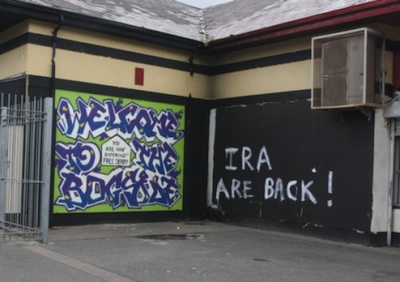
In a statement released yesterday [Thursday] evening, the new IRA grouping said that following extensive consultation, the three organisations “have come together within a united structure under a single leadership subservient to the constitution of the Irish Republican Army”.
A completely new command structure and army council has been established to oversee the running of the new organisation which will combine the resources of all three former groups. It is believed members of the three original groups have already been briefed on the merger.
The transition was helped by the fact that a majority of the new IRA’s leadership previously held senior roles within the Provisional IRA at various stages of that organisation’s existence.
The new organisation does not include the Continuity IRA. In addition, one or two elements which operated under the name Oglaigh na hEireann [the Irish synonym for IRA] may not have been brought into the new group, particularly in Belfast.
In a statement issued by the regrouped organisation’s army council, the IRA said it remained “committed to the full realisation of the ideals and principles enshrined in the proclamation of 1916”.
“In recent years the establishment of a free and independent Ireland has suffered set backs due to the failures among the leaders of Irish nationalism and fractures within republicanism,” it said.
“The root cause of conflict in our country is the subversion of the nation’s inalienable right to self determination and this has yet to be addressed.
“Instead the Irish people have been sold a phony peace rubber stamped by the token legislature in Stormont.”
It said the continuing British denial of Irish self-determination remained the source of the conflict.
“It is Britain, not the IRA that has chosen provocation and conflict,” it said.
“The IRA’s mandate for armed struggle derives from Britain’s denial of the fundamental right of the Irish people to national self-determination and sovereignty.
“So long as Britain persists in its denial of national and democratic rights in Ireland then the IRA will continue to assert those rights.
“The necessity of armed actions in pursuit of Irish freedom can be avoided through the removal of the British military presence from our country, the dismantling of their armed militia and declaration of an internationally observed timescale that details the dismantling of British political interference in our country.”
It is unclear what motivated the new development, but the breakaway organisations have reported a surge in support since Sinn Fein’s Martin McGuinness shook hands and greeted the English queen, Elizabeth Windsor, as part of the British royal jubilee celebrations last month.
The increased size and relative unity within the organisation will directly challenge long-standing efforts by the political establishment in the North to portray republican militants as small or “micro” groups.
For the moment, there seems no possibility of an engagement between the two, but in the future, the organisation’s new combined structure could allow a single, coherent channel of communication.
North Belfast Sinn Fein assembly member Gerry Kelly recently described the breakaway IRA groups as “small groupings” but insisted that his party had sought to engage with them.
“They have no right to carry out armed actions, the vast majority of which are directed against civilians in republican areas, in the name of Irish republicanism,” he said.
One of the group’s involved in the merger, Republican Action Against Drugs, has operated a controversial vigilante campaign against criminals within the nationalist community in Derry. However, last month it began to target the PSNI, triggering a wave of raids and searches in which dozens of homes were ransacked, most recently that of the Sinn Fein Mayor, Kevin Campbell.
Other units or groupings involved in the merger include one which carried out an attack which killed a member of the PSNI in County Tyrone last year, as well as others which have used the name Oglaigh na hEireann, or simply ‘the IRA’.
While the full extent of the regrouping has yet to be confirmed, it has been reported that the new IRA has membership ‘nationwide’.
Meanwhile, in an apparently separate development, the Continuity IRA (CIRA) says it has expelled several members and has a new leadership.
A statement issued in Dublin said those acting in a criminal manner and using the name of the CIRA would be subject to “military action”.
The group said it remains determined to continue its armed campaign in the north. The CIRA has claimed responsibility for several attacks in recent years, including one in 2009 in which a member of the PSNI was killed.
There has as yet been no direct response to the development by Sinn Fein or other IRA groups.
Five intelligence documents were deliberately withheld from the Smithwick Tribunal by the PSNI police, the force has said, deepening the mystery over a profoundly murky incident from 1989.
The ongoing tribunal at Dublin Castle was set up to investigate claims that the Provisional IRA received assistance from a member of the 26-County Garda police in 1989. It was announced following unionist demands for a ‘balance’ to nationalist calls for inquiries into collusion between the British Crown forces and loyalist death squads north of the border.
Two senior members of the police (then RUC) died when they were ambushed as they crossed the border en route to Dundalk Garda station, allegedly afer inside information was passed to the IRA.
The revelation that the PSNI had withheld the documents was described as a matter of “great concern” by lawyers at the tribunal on Wednesday. Lawyers for the two families involved said it now appeared the PSNI may be hiding even more documents from the inquiry, while lawyers for Owen Corrigan, a Garda member who had been accused of assisting the IRA, said the PSNI had very belatedly produced evidence which cleared his client.
John McBurney, solicitor for the Breen family, said there was now “a truly bewildering and alarming array of collusion pointers”.
The PSNI has provided only “summaries” of the five intelligence documents, the originals of which they said were being withheld for “reasons of national security”.
Four of the five “summaries” related to reports that a garda in Dundalk passed information to the IRA. The fifth said a Dundalk garda named as Jim Lane had repeatedly warned of inappropriate relationships between members of the IRA and Dundalk sergeants.
While the first two documents made reference to “a detective” member of the Garda in Dundalk who was said to be passing information to the IRA, the summary provided said the unnamed detective officer in question was not involved in [or revealed to] the Smithwick Tribunal.
Jim O’Callaghan SC, for Owen Corrigan, said this was “exculpatory” information about his client’s alleged involvement with the IRA, and the PSNI had decided, at least initially, not to share it.
Asked if he was prepared to apologise to Mr Corrigan, the PSNI representative replied: “A decision was taken to not release this intelligence.”
He added that he was “not in a position to tell you who made that decision, the circumstances or the context in which that or those decisions were taken. And I’d be speculating beyond that.”
A different take on last week’s IRA announcement, by socialist republican Tommy McKearney.
Organisations with strong centralised and hierarchal structures, especially the conviction driven, are usually prone to splitting or the breaking away of factions. Often this occurs at periods of significant political development or societal transformation when direction-changing decisions are required. This happens in religion, in sport and with unending regularity in the world of militant Irish republicanism. Three of the largest parties in the present Irish parliament, for example, had their origins in bitter divisions within the country’s republican milieu. Such a history, therefore, makes the news of a merging of certain forces within the present day republican underground, an interesting and indeed surprising development.
A small number of journalists were briefed on Thursday 26th July that three strands of what is sometimes referred to as the ‘physical force’ element of Irish republicanism had amalgamated. The Real IRA (best known to British readers for carrying out the 1998 Omagh bombing), a vigilante group called Republican Action Against Drugs and a low profile group of armed republicans still calling themselves ‘the IRA’ have united under the, hardly original, title of the Irish Republican Army. In its communique to the press, the group repeated its commitment to militarism when it spoke of the ‘... necessity of armed struggle in the pursuit of Irish freedom ...’
In spite of its newsworthiness, this development should be kept in perspective. In the first instance, this new IRA group will be confronted with a challenge experienced by every revolutionary organisation; that of maintaining security and secrecy in the face of energetic surveillance by the state. There is little doubt that this merger will simplify MI5’s task of monitoring and foiling the new group’s activities.
Secondly, there are two other bodies, still calling themselves the IRA that remains outside this merger. Therefore the fractious and divided nature of armed Irish republicanism remains as poisonous and debilitating as ever. The particular school of Irish republicanism represented in this new group is often more certain of what it opposes rather than what it stands for. This makes it difficult for them to build the type of broad support base necessary to influence the political process.
Most pertinent of all, though, is the fact that the new formation is unlikely to change significantly the balance of forces within Northern Ireland. Trying to estimate membership strength for the various militant groups is difficult because the level and depth of support can fluctuate widely depending on the time and circumstances. One of the anomalies of the current situation is that while Sinn Féin voters are strongly opposed to further armed action, many are unwilling for historical reasons to cooperate with the authorities. Acceptance for all aspects of policing remains ambiguous within most republican circles.
Nevertheless, an overwhelming majority of people in Northern Ireland are opposed to any resumption of the violent battle of the final quarter century of the 20thcentury. Every election since the Good Friday Agreement of 1998 has returned, from within the wider republican constituency, an overwhelming majority in favour of ending armed conflict and an equally strong rejection of those indicating any intention of recommencing insurrection. While there is no mechanical correlation between electoral support and ability or capacity to carry out direct action, the presiding officer’s count provides its own message. When people are unwilling to vote in secret for an insurrectionist candidate, they are unlikely to endure the unavoidable hardships and risks of war against the state. In practical terms there is insufficient water in which armed radicals can swim in Northern Ireland of the present day.
This low-key assessment notwithstanding; there is a message to be taken from a coming together of previously separate entities. It is rare for divisions in republican Ireland to be repaired or for groups to coalesce in this fashion. The significance of what has happened may not lie, therefore, in the new group’s potential for increased military capacity (and that is questionable hypothesis by any assessment) but in the fact that there is a new strategy in play and the process is towards unity rather than remaining separate.
Bear in mind that all is not well in Northern Ireland. Global recession is embedding economic and social hardship in areas that have experienced little improvement in their level of material prosperity over the last two decades. Sectarian divisions remain at a toxic level, especially in working class districts. Local devolved government performs a basic function of any parliament in that it is a substitute for civil war, yet it hardly makes any other obvious difference in the population’s day to day lives. Ominously, this new IRA is concentrated in the very areas where deprivation is most acute.
There is, in a nutshell, a space for dissenting voices to question the status quo and Irish republicanism is, after all, more a response to material conditions than it is an aspiration to a form of government. Five years ago a sense of estrangement manifested itself in France with youths burning property in the suburbs. Last year something similar happened in Britain when rioting broke out across urban centres.
Protest in Ireland sometimes follows an indigenous pattern and therein lurks the one great unknown factor in this latest ‘new departure’. Is this a huddling of desperate men determined to hang together rather than hang separately or is it an indication, even subconsciously, of a societal change that is encouraging direction-changing decisions?



 e-mail:
  Homepage:






 3
3



Comments